CAS 32387-21-6
:1-methylindole-3-carboxylic acid
Description:
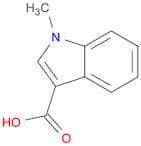
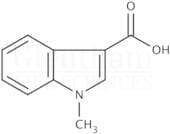
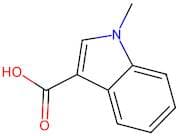
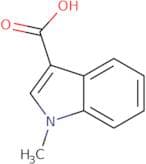
1-Methylindole-3-carboxylic acid is an organic compound characterized by its indole structure, which consists of a fused benzene and pyrrole ring. The presence of a methyl group at the first position and a carboxylic acid functional group at the third position contributes to its unique chemical properties. This compound typically appears as a solid or crystalline substance and is soluble in polar solvents due to the carboxylic acid group, which can engage in hydrogen bonding. It is often used in various chemical syntheses and may serve as an intermediate in the production of pharmaceuticals or agrochemicals. The compound's reactivity is influenced by the electron-rich indole ring, making it a potential candidate for electrophilic substitution reactions. Additionally, 1-methylindole-3-carboxylic acid may exhibit biological activity, which warrants further investigation in medicinal chemistry. As with many organic compounds, proper handling and safety precautions are essential due to potential toxicity or reactivity.
Formula:C10H9NO2
InChI:InChI=1/C10H9NO2/c1-11-6-8(10(12)13)7-4-2-3-5-9(7)11/h2-6H,1H3,(H,12,13)
SMILES:Cn1cc(c2ccccc12)C(=O)O
Synonyms:- 1-methyl-1H-indole-3-carboxylic acid
Sort by
Purity (%)
0
100
|
0
|
50
|
90
|
95
|
100
Found 7 products.
1-Methyl-1H-indole-3-carboxylic acid
CAS:Formula:C10H9NO2Purity:97%Color and Shape:SolidMolecular weight:175.1840Ramosetron Impurity 7
CAS:Formula:C10H9NO2Color and Shape:White To Off-White SolidMolecular weight:175.191-Methyl-1H-indole-3-carboxylic acid
CAS:1-Methyl-1H-indole-3-carboxylic acid
Purity:97%Molecular weight:175.18g/mol1-Methylindole-3-carboxylic acid
CAS:Formula:C10H9NO2Purity:98%Color and Shape:White powderMolecular weight:175.1871-Methylindole-3-carboxylic acid
CAS:Controlled Product1-Methylindole-3-carboxylic acid is a 5-HT7 receptor antagonist that blocks the action of serotonin on the 5-HT7 receptor. This compound has been shown to reduce the constriction of lymphatic vessels, which may lead to lower blood pressure. 1-Methylindole-3-carboxylic acid is also used as a tool for studying spontaneous reactions in vessels and kidney tissue. Its effects on the vascular system can be observed by measuring changes in flow and volume of perfusion. 1-Methylindole-3-carboxylic acid has been shown to increase chloride, which leads to vasoconstriction and an increased blood pressure. It also causes vasodilation due to an increase in potassium levels. Intraluminal administration of glibenclamide, a drug that lowers blood sugar levels, increases dehydration by reducing water absorption from the intestine into the bloodstream.Formula:C10H9NO2Purity:Min. 95%Molecular weight:175.18 g/mol