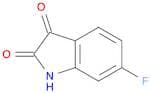
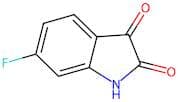
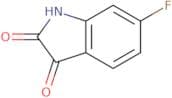
CAS 324-03-8
:6-fluoro-1H-indole-2,3-dione
Description:
6-Fluoro-1H-indole-2,3-dione, with the CAS number 324-03-8, is a synthetic organic compound that belongs to the indole family, characterized by its bicyclic structure containing a fused benzene and pyrrole ring. This compound features a fluorine atom at the 6-position and two carbonyl groups at the 2 and 3 positions, which contribute to its reactivity and potential biological activity. It is typically a solid at room temperature and may exhibit a range of solubility in organic solvents, depending on the specific conditions. The presence of the fluorine atom can enhance the compound's lipophilicity and influence its interaction with biological targets. 6-Fluoro-1H-indole-2,3-dione has garnered interest in medicinal chemistry due to its potential applications in drug development, particularly in the context of anticancer and antimicrobial agents. Its reactivity can be attributed to the electrophilic nature of the carbonyl groups, making it a versatile intermediate in organic synthesis. Safety and handling precautions should be observed, as with many chemical substances, due to potential toxicity and reactivity.
Formula:C8H4FNO2
InChI:InChI=1/C8H4FNO2/c9-4-1-2-5-6(3-4)10-8(12)7(5)11/h1-3H,(H,10,11,12)
SMILES:c1cc2c(cc1F)NC(=O)C2=O
Synonyms:- 1H-indole-2,3-dione, 6-fluoro-
- 6-Fluoroisatine
- 6-Fluoroisatin
- 6-Fluoroindoline-2,3-Dione
- 6-Fluoro-1H-indole-2,3-dione
Sort by
Purity (%)
0
100
|
0
|
50
|
90
|
95
|
100
Found 5 products.
6-Fluoroindoline-2,3-dione
CAS:Formula:C8H4FNO2Purity:97%Color and Shape:SolidMolecular weight:165.1213Ref: IN-DA0034D1
1kgTo inquire5kgTo inquire500gTo inquire250mg20.00€1g25.00€5g33.00€10g53.00€25g82.00€6-Fluoroisatin
CAS:6-Fluoroisatin is a fluorescent probe that binds to specific DNA and RNA sequences. 6-Fluoroisatin has been shown to bind to both DNA and RNA with high affinity, and has been used as a reagent for the detection of these nucleic acids. The fluoro group in 6-fluoroisatin allows for positron emission by converting fluorine into positrons when it is irradiated by electrons. This reaction can be used to detect specific dna or RNA sequences in a receptor binding assay. 6-Fluoroisatin also reacts with carbonyl groups and other electron rich molecules, which makes it useful as an additive in the study of reactivity.Formula:C8H4FNO2Purity:Min. 95%Color and Shape:PowderMolecular weight:165.12 g/mol