CAS 3250-74-6
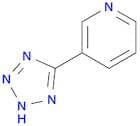
:3-(2H-Tetrazol-5-yl)pyridine
Description:
3-(2H-Tetrazol-5-yl)pyridine, with the CAS number 3250-74-6, is a heterocyclic compound that features both a pyridine and a tetrazole moiety. This compound is characterized by its aromatic nature, which contributes to its stability and reactivity. The presence of the tetrazole ring, known for its ability to form hydrogen bonds and participate in coordination chemistry, enhances the compound's potential for biological activity and interaction with metal ions. It is typically a solid at room temperature and may exhibit solubility in polar organic solvents. The compound's structure allows for various functionalization possibilities, making it of interest in medicinal chemistry and material science. Additionally, its unique combination of nitrogen-rich tetrazole and aromatic pyridine can impart interesting electronic properties, which may be exploited in the development of pharmaceuticals or agrochemicals. Overall, 3-(2H-Tetrazol-5-yl)pyridine is a versatile compound with potential applications in various fields of chemistry.
Formula:C6H5N5
InChI:InChI=1S/C6H5N5/c1-2-5(4-7-3-1)6-8-10-11-9-6/h1-4H,(H,8,9,10,11)
InChI key:InChIKey=SECHDFHDDVELCV-UHFFFAOYSA-N
SMILES:C=1(NN=NN1)C=2C=CC=NC2
Synonyms:- 3-(1H-Tetrazol-5-yl)pyridine
- 3-(2H-tetrazol-5-yl)pyridine
- 5-(3-Pyridinyl)-1H-tetrazole
- 5-(3-Pyridyl)-1H-tetrazole
- 5-(3-Pyridyl)tetrazole
- 5-(Pyridin-3-yl)tetrazole
- 5-Pyridin-3-Yltetrazol-1-Ide
- 5-β-Pyridyltetrazole
- Lu 31-102
- Pyridine, 3-(1H-tetrazol-5-yl)-
- Pyridine, 3-(2H-tetrazol-5-yl)-
- See more synonyms
Sort by
Purity (%)
0
100
|
0
|
50
|
90
|
95
|
100
Found 5 products.
3-(2H-TETRAZOL-5-YL)-PYRIDINE
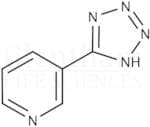
CAS:Formula:C6H5N5Purity:98%Color and Shape:SolidMolecular weight:147.13745-(3-Pyridyl)-1H-tetrazole
CAS:Formula:C6H5N5Purity:98.0%Color and Shape:No data available.Molecular weight:147.1415-(3-Pyridyl)-1H-tetrazole
CAS:5-(3-Pyridyl)-1H-tetrazole is a heterocyclic compound that belongs to the class of isomeric compounds. The nitrogen atoms are located in a plane and are separated by three carbon atoms, forming a trigonal planar structure. 5-(3-Pyridyl)-1H-tetrazole has been shown to activate plasma cholesterol levels through the generation of fatty acid hydroperoxides and oxidation products, which can lead to cell apoptosis. It also has the ability to catalyze reactions and form supramolecular complexes with other molecules. One such complex is formed with annexin, which may be due to hydrogen bonding interactions between the two molecules.Formula:C6H5N5Purity:Min. 95%Molecular weight:147.14 g/mol5-(Pyridin-3-yl)-1H-tetrazole
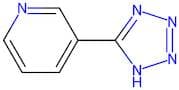
CAS:5-(Pyridin-3-yl)-1H-tetrazole
Purity:98+%Molecular weight:147.14g/mol