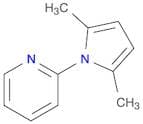
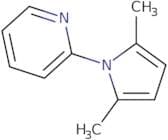
CAS 32570-88-0
:2,5-Dimethyl-1-(2-pyridyl)pyrrole
Description:
2,5-Dimethyl-1-(2-pyridyl)pyrrole is an organic compound characterized by its pyrrole ring structure, which is a five-membered aromatic heterocycle containing nitrogen. This compound features two methyl groups at the 2 and 5 positions of the pyrrole ring, enhancing its lipophilicity and potentially influencing its reactivity and solubility in organic solvents. The presence of a 2-pyridyl substituent at the 1-position introduces additional aromatic character and can participate in various interactions, such as hydrogen bonding and coordination with metal ions. This compound may exhibit interesting biological activities due to its structural features, making it a subject of interest in medicinal chemistry and material science. Its synthesis typically involves the reaction of pyrrole derivatives with appropriate alkylating agents or through cyclization reactions. As with many nitrogen-containing heterocycles, it may display unique electronic properties, which can be exploited in applications such as organic electronics or as ligands in coordination chemistry. Safety data should be consulted for handling and storage, as with all chemical substances.
Formula:C11H12N2
InChI:InChI=1/C11H12N2/c1-9-6-7-10(2)13(9)11-5-3-4-8-12-11/h3-8H,1-2H3
SMILES:Cc1ccc(C)n1c1ccccn1
Synonyms:- 2,5-Dimethyl-1-(2-pyridinyl)-1H-pyrrole
- 2-(2,5-dimethyl-1H-pyrrol-1-yl)pyridine
Sort by
Purity (%)
0
100
|
0
|
50
|
90
|
95
|
100
Found 3 products.
2-(2,5-Dimethyl-1H-pyrrol-1-yl)pyridine
CAS:2-(2,5-Dimethyl-1H-pyrrol-1-yl)pyridinePurity:95%Molecular weight:172.23g/mol2-(2,5-Dimethyl-1H-pyrrol-1-yl)pyridine
CAS:2-(2,5-Dimethyl-1H-pyrrol-1-yl)pyridine is a pyrrole derivative that has been shown to undergo multistep reactions. It can be used as a starting material for the synthesis of other compounds, such as sulfophenylpyrroles and pyridinium salts. The reaction of 2-(2,5-dimethyl-1H-pyrrol-1-yl)pyridine with perchlorates generates an electron rich intermediate, which is susceptible to oxidation by air or hydrogen peroxide. This process leads to the production of aliphatic sulfoxides and sulfones. The reaction product can then react with amines to form zirconium complexes with unusual geometry and steric interactions.!--END-->Formula:C11H12N2Purity:Min. 95%Molecular weight:172.23 g/mol