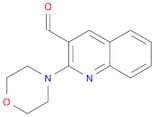
CAS 326008-62-2
:2-(morpholin-4-yl)quinoline-3-carbaldehyde
Description:
2-(Morpholin-4-yl)quinoline-3-carbaldehyde is a chemical compound characterized by its unique structure, which combines a quinoline moiety with a morpholine group and an aldehyde functional group. This compound typically appears as a solid or liquid, depending on its purity and specific conditions. It is known for its potential applications in medicinal chemistry, particularly in the development of pharmaceuticals due to its ability to interact with biological targets. The presence of the morpholine ring contributes to its solubility and biological activity, while the aldehyde group can participate in various chemical reactions, such as condensation and reduction. Additionally, this compound may exhibit fluorescence properties, making it useful in biological imaging or as a probe in chemical assays. Its synthesis often involves multi-step organic reactions, and it is important to handle it with care due to potential reactivity associated with the aldehyde group. Overall, 2-(morpholin-4-yl)quinoline-3-carbaldehyde is a versatile compound with significant implications in research and development within the field of chemistry and pharmacology.
Formula:C14H14N2O2
InChI:InChI=1/C14H14N2O2/c17-10-12-9-11-3-1-2-4-13(11)15-14(12)16-5-7-18-8-6-16/h1-4,9-10H,5-8H2
SMILES:c1ccc2c(c1)cc(C=O)c(n2)N1CCOCC1
Synonyms:- 3-Quinolinecarboxaldehyde, 2-(4-Morpholinyl)-
- 2-(Morpholin-4-yl)quinoline-3-carbaldehyde
- 2-morpholin-4-ylquinoline-3-carbaldehyde(SALTDATA: FREE)
- 2-Morpholinoquinoline-3-carbaldehyde
- OTAVA-BB 7020617837
- CHEMBRDG-BB 6985995
Sort by
Purity (%)
0
100
|
0
|
50
|
90
|
95
|
100
Found 2 products.
2-Morpholin-4-ylquinoline-3-carbaldehyde
CAS:<p>2-Morpholin-4-ylquinoline-3-carbaldehyde is a synthetic antibacterial agent. It has been shown to be effective against Streptococcus pyogenes, Mycobacterium tuberculosis, and other bacterial strains. 2-Morpholin-4-ylquinoline-3-carbaldehyde binds to the enzyme DNA gyrase, which is necessary for DNA replication, and inhibits its function. This compound also binds to the enzyme topoisomerase IV and interferes with its function. The antituberculosis activity of this drug is due to its ability to inhibit the growth of mycobacteria by binding to the ribosome in these organisms and inhibiting protein synthesis. 2-Morpholin-4-ylquinoline-3-carbaldehyde also has antimalarial properties as it inhibits quinine efflux from erythrocytes infected with Plasmodium falciparum.</p>Formula:C14H14N2O2Purity:Min. 95%Molecular weight:242.27 g/mol