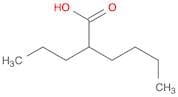
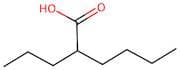
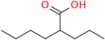
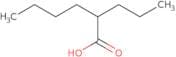
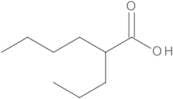
CAS 3274-28-0
:2-Propylhexanoic acid
Description:
2-Propylhexanoic acid, with the CAS number 3274-28-0, is a branched-chain fatty acid characterized by its unique structure, which includes a propyl group attached to the second carbon of a hexanoic acid backbone. This compound is a colorless to pale yellow liquid at room temperature and has a relatively low volatility. It is soluble in organic solvents but has limited solubility in water due to its hydrophobic nature. The acid features a carboxylic functional group, which imparts acidic properties and allows it to participate in various chemical reactions, such as esterification and amidation. 2-Propylhexanoic acid is often used in the synthesis of surfactants, lubricants, and plasticizers, and it can also serve as an intermediate in the production of other chemical compounds. Its branched structure contributes to its unique physical and chemical properties, making it valuable in industrial applications. Safety data indicates that, like many organic acids, it should be handled with care to avoid skin and eye irritation.
Formula:C9H18O2
InChI:InChI=1/C9H18O2/c1-3-5-7-8(6-4-2)9(10)11/h8H,3-7H2,1-2H3,(H,10,11)
InChI key:InChIKey=HWXRWNDOEKHFTL-UHFFFAOYSA-N
SMILES:C(CCCC)(CCC)C(O)=O
Synonyms:- 4-Octanecarboxylic acid
- Hexanoic Acid, 2-Propyl-
- 2-Propylhexanoic acid
- PROPYLBUTYLACETICACID
- 2-Butyl Valeric Acid
- Valeric Acid Impurity 1 (2-Propyl Hexanoic Acid)
- 2-propyl-hexanoicaci
- HEXANOICACID,2-PROPYL-
- Butyl Valproic Acid
Sort by
Purity (%)
0
100
|
0
|
50
|
90
|
95
|
100
Found 8 products.
2-Propylhexanoic acid
CAS:2-Propylhexanoic acid is a fatty acid that is naturally present in the human body. It has been shown to be an effective inhibitor of malonic acid decarboxylase (MAD) and aldehyde dehydrogenase (ALDH). 2-Propylhexanoic acid has been shown to induce apoptosis in glioma cells at concentrations of 1 µM or higher. The molecular descriptors, plasma concentrations, and endpoints for this compound have been determined by using a chromatographic method. 2-Propylhexanoic acid copolymerizes with the monomers styrene and acrylic acid at a reaction time of 30 minutes, producing a polymer that can be used as an implant material.Formula:C9H18O2Purity:Min. 97%Color and Shape:Clear LiquidMolecular weight:158.24 g/mol2-Propylhexanoic Acid
CAS:Controlled ProductApplications An impurity found in valproic acid (V094750, S674500).
References Haj-Yehia, A., et al.: Pharm. Res., 6, 683 (1989), Davis, R., et al.: Drugs, 47, 332 (1994), Haj-Yehia, A., et al.: J. Pharm. Sci., 79, 719 (1990),Formula:C9H18O2Color and Shape:Colourless To Light YellowMolecular weight:158.24