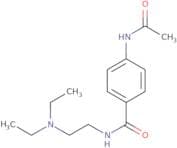
CAS 32795-44-1
:N-Acetylprocainamide
Description:
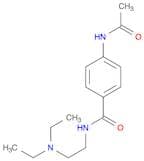
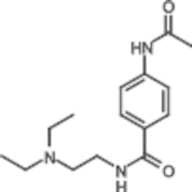
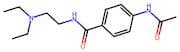
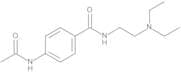
N-Acetylprocainamide is a chemical compound that serves as an antiarrhythmic agent, primarily used in the treatment of cardiac arrhythmias. It is a derivative of procainamide, featuring an acetyl group that enhances its pharmacological properties. The compound is characterized by its ability to block sodium channels, which stabilizes cardiac cell membranes and helps restore normal heart rhythm. N-Acetylprocainamide is typically administered in a clinical setting and is known for its moderate efficacy and side effect profile, which may include gastrointestinal disturbances and potential impacts on blood cell counts. The compound is soluble in water and exhibits a moderate molecular weight, making it suitable for intravenous administration. Its chemical structure includes an aromatic ring, an amide functional group, and an aliphatic chain, contributing to its biological activity. As with many pharmaceuticals, careful monitoring of dosage and patient response is essential to optimize therapeutic outcomes while minimizing adverse effects.
Formula:C15H23N3O2
InChI:InChI=1S/C15H23N3O2/c1-4-18(5-2)11-10-16-15(20)13-6-8-14(9-7-13)17-12(3)19/h6-9H,4-5,10-11H2,1-3H3,(H,16,20)(H,17,19)
InChI key:InChIKey=KEECCEWTUVWFCV-UHFFFAOYSA-N
SMILES:C(NCCN(CC)CC)(=O)C1=CC=C(NC(C)=O)C=C1
Synonyms:- 4-(acetylamino)-N-[2-(diethylamino)ethyl]benzamide
- 4-(acetylamino)-N-[2-(diethylamino)ethyl]benzamide hydrochloride (1:1)
- Acecainide
- Benzamide, 4-(acetylamino)-N-[2-(diethylamino)ethyl]-
- N-Acetylnovocainamide
- N-Acetylprocaine amide
- N-Acetylprocainamide
Sort by
Purity (%)
0
100
|
0
|
50
|
90
|
95
|
100
Found 8 products.
N-Acetylprocainamide
CAS:Formula:C15H23N3O2Purity:98.0%Color and Shape:SolidMolecular weight:277.3620N-Acetylprocainamide
CAS:N-Acetylprocainamide (NAPA), the N-acetylated metabolite of Procainamide, is a Class III antiarrhythmic agent, while procainamide is a Class Ia antiarrhythmicFormula:C15H23N3O2Purity:99.65% - 99.74%Color and Shape:SolidMolecular weight:277.36N-Acetylprocainamide
CAS:N-Acetylprocainamide is a prodrug that is hydrolyzed in vivo to procainamide, its active form. Procainamide is used for the treatment of cardiac arrhythmias, but has been shown to have minimal toxicity. N-acetylprocainamide has been shown to be effective in experimental models and has minimal toxicity in long-term studies. This drug can be administered orally or intravenously and has been shown to have a low rate constant. The analytical method for this drug is chromatographic analysis.Formula:C15H23N3O2Purity:Min. 95%Molecular weight:277.36 g/mol