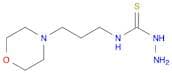
![4-[3-(4-Morpholino)propyl]-3-thiosemicarbazide](/_next/image/?url=https%3A%2Fstatic.cymitquimica.com%2Fcas-image%2Fthumb-webp%2F221756-4-3-4-morpholino-propyl-3-thiosemicarbazide.webp&w=3840&q=75)
CAS 32813-48-2
:4-[3-(4-Morpholino)propyl]-3-thiosemicarbazide
Description:
4-[3-(4-Morpholino)propyl]-3-thiosemicarbazide is a chemical compound characterized by its thiosemicarbazide functional group, which is known for its potential biological activity, particularly in medicinal chemistry. The presence of the morpholino group enhances its solubility and may contribute to its pharmacological properties. This compound typically appears as a solid and may exhibit moderate stability under standard conditions. It is soluble in polar solvents, which is common for thiosemicarbazides due to their ability to form hydrogen bonds. The compound may possess various biological activities, including antimicrobial and anticancer properties, making it of interest in drug development. Its structure allows for potential interactions with biological targets, which can be explored in pharmacological studies. Safety and handling precautions should be observed, as with many organic compounds, due to potential toxicity or reactivity. Overall, 4-[3-(4-Morpholino)propyl]-3-thiosemicarbazide represents a class of compounds that are valuable in research and therapeutic applications.
Formula:C8H18N4OS
InChI:InChI=1/C8H18N4OS/c9-11-8(14)10-2-1-3-12-4-6-13-7-5-12/h1-7,9H2,(H2,10,11,14)
SMILES:C(CN=C(NN)S)CN1CCOCC1
Synonyms:- Morpholinopropyl thiosemicarbazide
- 4-(3-Morpholinopropyl)-3-____
- N-[3-(morpholin-4-yl)propyl]hydrazinecarbothioamide
Sort by
Purity (%)
0
100
|
0
|
50
|
90
|
95
|
100
Found 4 products.
4-(3-Morpholinopropyl)-3-thiosemicarbazide
CAS:4-(3-Morpholinopropyl)-3-thiosemicarbazide
Molecular weight:218.31972g/mol4-(3-Morpholinopropyl)-3-thiosemicarbazide
CAS:Formula:C8H18N4OSColor and Shape:SolidMolecular weight:218.324-(3-Morpholinopropyl)-3-thiosemicarbazide
CAS:4-(3-Morpholinopropyl)-3-thiosemicarbazide is a thiadiazine compound that inhibits protein glycation and glycation. It has been shown to effectively inhibit glycation in vitro and vivo with the model system. 4-(3-Morpholinopropyl)-3-thiosemicarbazide has been shown to have anti-inflammatory properties, which may be due to its ability to block the formation of advanced glycated end products (AGEs) by blocking the reaction between glucose and proteins.Formula:C8H18N4OSPurity:Min. 95%Molecular weight:218.32 g/mol