CAS 33016-47-6
:1-Trityl-1H-imidazole-4-carboxaldehyde
Description:
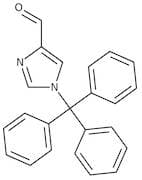
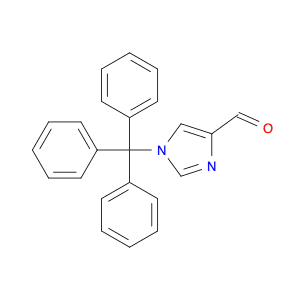
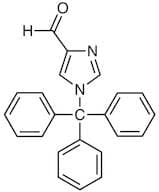
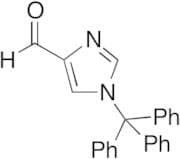
1-Trityl-1H-imidazole-4-carboxaldehyde is a chemical compound characterized by its imidazole ring, which is a five-membered aromatic heterocycle containing two nitrogen atoms. The presence of a trityl group, which is a bulky phenyl group attached to a carbon atom, enhances the compound's stability and solubility in organic solvents. The aldehyde functional group at the 4-position of the imidazole ring is reactive, allowing for various chemical transformations, including condensation and reduction reactions. This compound is often utilized in organic synthesis and medicinal chemistry due to its potential as an intermediate in the preparation of biologically active molecules. Its unique structural features contribute to its utility in various applications, including as a building block in the synthesis of pharmaceuticals and agrochemicals. Additionally, the compound's properties, such as melting point, boiling point, and solubility, can vary based on the specific conditions and solvents used in experiments. Overall, 1-Trityl-1H-imidazole-4-carboxaldehyde is a versatile compound with significant relevance in chemical research.
Formula:C23H18N2O
InChI:InChI=1/C23H18N2O/c26-17-22-16-25(18-24-22)23(19-10-4-1-5-11-19,20-12-6-2-7-13-20)21-14-8-3-9-15-21/h1-18H
SMILES:c1ccc(cc1)C(c1ccccc1)(c1ccccc1)n1cc(C=O)nc1
Synonyms:- 1-Tritylimidazole-4-carboxaldehyde
- 1-Trityl-1H-imidazole-4-carbaldehyde
- 1-Tritylimidazole-4-Carboxaldehude
- 1-(Triphenylmethyl)imidazole-4-carboxaldehyde
- 4-Formyl-1-tritylimidazole
- 1-Triphenylmethyl-1H-imidazole-4-formaldehyde
- 1-Trityl-Imdazole-4-Carboxadehyde
Sort by
Purity (%)
0
100
|
0
|
50
|
90
|
95
|
100
Found 10 products.
1-Tritylimidazole-4-carboxaldehyde, 98%
CAS:1-Tritylimidazole-4-carboxaldehyde is used in the synthesis of histamine and girolline This Thermo Scientific Chemicals brand product was originally part of the Alfa Aesar product portfolio. Some documentation and label information may refer to the legacy brand. The original Alfa Aesar product / iteFormula:C23H18N2OPurity:98%Color and Shape:White to pale yellow, PowderMolecular weight:338.411-Tritylimidazole-4-carboxaldehyde
CAS:Formula:C23H18N2OPurity:95%Color and Shape:SolidMolecular weight:338.40181-Trityl-1H-imidazole-4-carboxaldehyde
CAS:1-Trityl-1H-imidazole-4-carboxaldehydeFormula:C23H18N2OPurity:95%Color and Shape: white to off white powderMolecular weight:338.40g/mol1-Tritylimidazole-4-carboxaldehyde
CAS:Formula:C23H18N2OPurity:>98.0%(T)(HPLC)Color and Shape:White to Yellow to Orange powder to crystalMolecular weight:338.41N-(Triphenylmethyl)-4-imidazolecarboxaldehyde
CAS:Controlled ProductApplications N-(Triphenylmethyl)-4-imidazolecarboxaldehyde is an intermediate in the preparation of dialkylimidazole based sterol 14α-demethylase inhibitors as potential anti-trypanosoma cruzi agents.
References Suryadevara, P.K., et al.: Bioorg. Med. Chem. Lett., 23, 6492 (2013);Formula:C23H18N2OColor and Shape:NeatMolecular weight:338.41-Tritylimidazole-4-carboxaldehyde
CAS:Purity:95.0%Color and Shape:Solid, White to reddish yellow powderMolecular weight:338.41000366210941-Trityl-1H-imidazole-4-carbaldehyde
CAS:1-Trityl-1H-imidazole-4-carbaldehyde is a phosphorane that has been synthesized in the laboratory. It is an organometallic compound with a chloroformate ligand and a mononuclear, dimethylformamide complex. 1-Trityl-1H-imidazole-4-carbaldehyde has shown to be an electrophile and binds to receptor sites with high affinity. This may be due to its ability to form hydrogen bonds with the receptor site, which often occurs for pharmacokinetic profiles.
Formula:C23H18N2OPurity:Min. 95%Molecular weight:338.4 g/mol