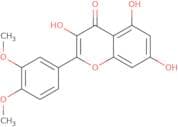
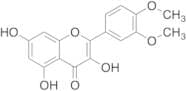
CAS 3306-29-4
:Quercetin 3′,4′-dimethyl ether
Description:
Quercetin 3′,4′-dimethyl ether, also known by its CAS number 3306-29-4, is a flavonoid compound derived from the flavonoid quercetin, characterized by the presence of two methoxy groups at the 3′ and 4′ positions of the aromatic ring. This modification enhances its solubility and bioavailability compared to its parent compound. Quercetin 3′,4′-dimethyl ether exhibits antioxidant properties, which help in neutralizing free radicals and reducing oxidative stress in biological systems. It is also known for its potential anti-inflammatory, antiviral, and anticancer activities, making it of interest in pharmacological research. The compound is typically found in various plants and foods, contributing to the health benefits associated with a diet rich in fruits and vegetables. Its stability and reactivity can be influenced by environmental factors such as pH and temperature, which are important considerations in both laboratory and industrial applications. Overall, Quercetin 3′,4′-dimethyl ether represents a significant area of study in natural product chemistry and its implications for health and disease prevention.
Formula:C17H14O7
InChI:InChI=1S/C17H14O7/c1-22-11-4-3-8(5-12(11)23-2)17-16(21)15(20)14-10(19)6-9(18)7-13(14)24-17/h3-7,18-19,21H,1-2H3
InChI key:InChIKey=MHALJYZRPGYQSI-UHFFFAOYSA-N
SMILES:O=C1C=2C(OC(=C1O)C3=CC(OC)=C(OC)C=C3)=CC(O)=CC2O
Synonyms:- 2-(3,4-Dimethoxyphenyl)-3,5,7-trihydroxy-4H-1-benzopyran-4-one
- 3′,4′-Di-O-methylquercetin
- 3′,4′-Dimethoxyquercetin
- 4H-1-benzopyran-4-one, 2-(3,4-dimethoxyphenyl)-3,5,7-trihydroxy-
- Dillenetin
- Flavone, 3,5,7-trihydroxy-3′,4′-dimethoxy-
- Quercetin 3′,4′-di-O-methyl ether
- Quercetin 3′,4′-dimethyl ether
- Quercetol 3′,4′-dimethyl ether
Sort by
Purity (%)
0
100
|
0
|
50
|
90
|
95
|
100
Found 2 products.
Dillenetin
CAS:Dillenetin is a flavonoid compound, which is derived from natural plant sources, particularly found in the genus Dillenia. It exhibits significant bioactivity with a mode of action primarily involving the modulation of cell signaling pathways. Dillenetin is known to bind to specific enzymes and receptors, influencing cellular processes such as proliferation, apoptosis, and oxidative stress responses.
Formula:C17H14O7Purity:Min. 95%Color and Shape:PowderMolecular weight:330.29 g/mol