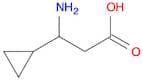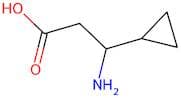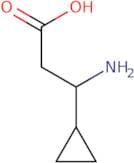
CAS 331633-72-8
:Cyclopropanepropanoic acid, b-amino-
Description:
Cyclopropanepropanoic acid, b-amino- is a chemical compound characterized by its unique structure that includes a cyclopropane ring and an amino group attached to a propanoic acid moiety. This compound features a three-membered cyclopropane ring, which contributes to its strain and reactivity, making it an interesting subject for synthetic and medicinal chemistry. The presence of the amino group indicates potential for forming hydrogen bonds, influencing its solubility and reactivity in biological systems. Additionally, the carboxylic acid functional group provides acidic properties, allowing for proton donation in various chemical reactions. The compound's structural features suggest potential applications in pharmaceuticals, particularly in the development of novel drugs or as intermediates in organic synthesis. Its specific properties, such as melting point, boiling point, and reactivity, would depend on the molecular interactions and the environment in which it is studied. Overall, cyclopropanepropanoic acid, b-amino- exemplifies the complexity and versatility of small organic molecules in chemical research.
Formula:C6H11NO2
Sort by
Purity (%)
0
100
|
0
|
50
|
90
|
95
|
100
Found 4 products.
3-Amino-3-cyclopropylpropanoic acid
CAS:Formula:C6H11NO2Purity:97%Color and Shape:SolidMolecular weight:129.15703-Amino-3-cyclopropylpropanoic acid
CAS:3-Amino-3-cyclopropylpropanoic acidPurity:97%Molecular weight:129.159g/mol3-Amino-3-cyclopropylpropanoic acid
CAS:Formula:C6H11NO2Purity:97%Color and Shape:SolidMolecular weight:129.1593-Amino-3-cyclopropylpropanoic acid
CAS:3-Amino-3-cyclopropylpropanoic acid is a mandelic acid that is an ester of tartaric acid. It is used as a raw material in the production of 3-amino-2,2-dimethylpropanoic acid, which is an intermediate for the synthesis of 2,4-diaminopyrimidine. 3-Amino-3-cyclopropylpropanoic acid can be produced by the esterification of tartaric acid with cyclopropanecarboxaldehyde. This compound has enantiomerically pure (R) and (S) forms. The racemic mixture can be separated into its diastereomers by crystallization with malonic or mandelic acids. The diastereomers are then converted to their corresponding diastereomeric salts and neutralized with an alkali such as sodium hydroxide to produce their corresponding free amine.Formula:C6H11NO2Purity:Min. 95%Molecular weight:129.16 g/mol