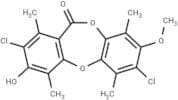
![2,7-dichloro-3-hydroxy-8-methoxy-1,4,6,9-tetramethyl-11H-dibenzo[b,e][1,4]dioxepin-11-one](/_next/image/?url=https%3A%2Fstatic.cymitquimica.com%2Fcas-image%2Fthumb-webp%2F1874494-27-dichloro-3-hydroxy-8-methoxy-1469-tetramethyl-11h-dibenzo-b-e-14-dioxepin-11-one.webp&w=3840&q=75)
CAS 33211-22-2
:2,7-dichloro-3-hydroxy-8-methoxy-1,4,6,9-tetramethyl-11H-dibenzo[b,e][1,4]dioxepin-11-one
Description:
2,7-Dichloro-3-hydroxy-8-methoxy-1,4,6,9-tetramethyl-11H-dibenzo[b,e][1,4]dioxepin-11-one, with CAS number 33211-22-2, is a complex organic compound characterized by its unique molecular structure, which includes multiple functional groups such as hydroxyl, methoxy, and dichloro substituents. This compound belongs to the class of dibenzo[dioxepins], which are known for their potential biological activities. The presence of chlorine atoms and methoxy groups can influence its reactivity and solubility, making it of interest in various chemical and pharmaceutical applications. The tetramethyl groups contribute to its hydrophobic nature, which may affect its interaction with biological membranes. Additionally, the compound's structural features suggest potential applications in medicinal chemistry, particularly in the development of therapeutic agents. Its synthesis and characterization would typically involve advanced organic synthesis techniques, and its properties would be studied using methods such as spectroscopy and chromatography to understand its behavior in different environments.
Formula:C18H16Cl2O5
InChI:InChI=1/C18H16Cl2O5/c1-6-10-14(8(3)13(21)11(6)19)24-16-7(2)12(20)15(23-5)9(4)17(16)25-18(10)22/h21H,1-5H3
Synonyms:- 11H-Dibenzo(b,e)(1,4)dioxepin-11-one, 2,7-dichloro-3-hydroxy-8-methoxy-1,4,6,9-tetramethyl-
Sort by
The purity filter is not visible because current products do not have associated purity data for filtering.
Found 1 products.
Vicanicin
CAS:Vicanicin is an aryl phenol ether compound found in lichens. It inhibits the expression of Hsp70, modulates intracellular redox-sensitive mechanisms, increases reactive oxygen species (ROS) in cancer cells, alters the Bax/Bcl-2 ratio, activates caspase-3, and induces apoptosis. Vicanicin suppresses cell growth and promotes apoptosis in androgen-sensitive (LNCaP) and androgen-insensitive (DU-145) human prostate cancer cells. It holds potential for prostate cancer research.Formula:C18H16Cl2O5Color and Shape:SolidMolecular weight:383.223