CAS 33265-60-0
:1-(2-Nitrophenyl)pyrrole
Description:
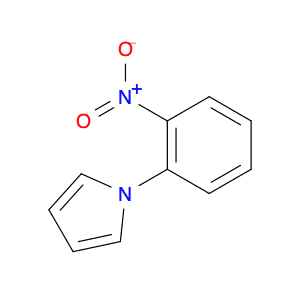
1-(2-Nitrophenyl)pyrrole is an organic compound characterized by the presence of a pyrrole ring substituted with a nitrophenyl group. The pyrrole moiety is a five-membered aromatic heterocycle containing four carbon atoms and one nitrogen atom, which contributes to its aromatic properties and reactivity. The nitrophenyl group, derived from a phenyl ring with a nitro substituent, introduces both electron-withdrawing characteristics and potential sites for further chemical reactions. This compound typically exhibits a yellow to orange color due to the presence of the nitro group, which can also influence its solubility and stability in various solvents. 1-(2-Nitrophenyl)pyrrole may be used in various applications, including organic synthesis, materials science, and as a potential intermediate in the development of pharmaceuticals or agrochemicals. Its reactivity can be attributed to the electron-deficient nature of the nitrophenyl group, making it a candidate for electrophilic substitution reactions. Safety data should be consulted, as nitro compounds can pose health risks and environmental concerns.
Formula:C10H8N2O2
InChI:InChI=1/C10H8N2O2/c13-12(14)10-6-2-1-5-9(10)11-7-3-4-8-11/h1-8H
SMILES:c1ccc(c(c1)n1cccc1)N(=O)=O
Synonyms:- 1-(2-nitrophenyl)-1H-pyrrolato(2-)
Sort by
Purity (%)
0
100
|
0
|
50
|
90
|
95
|
100
Found 4 products.
1-(2-Nitrophenyl)-1H-pyrrole
CAS:Formula:C10H8N2O2Purity:95%Color and Shape:SolidMolecular weight:188.18271-(2-nitrophenyl)-1H-pyrrole
CAS:1-(2-nitrophenyl)-1H-pyrrolePurity:≥95%Color and Shape:SolidMolecular weight:188.18g/mol1-(2-Nitrophenyl)pyrrole
CAS:1-(2-Nitrophenyl)pyrrole (1-NPyr) is an activated form of pyrrole that is synthesized by the Saccharomyces cerevisiae strain. It can be reduced with borohydride to produce 1-aminonitrobenzene. 1-NPyr has been shown to be used as a precursor for the synthesis of various drugs, including multidrugs and anilines. This compound is enantiopure and thermodynamically stable, making it an ideal candidate for asymmetric synthesis.Formula:C10H8N2O2Purity:Min. 95%Molecular weight:188.18 g/mol