CAS 33289-76-8
:tyr-bradykinin
Description:
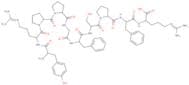
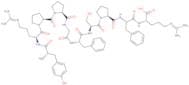
Tyr-bradykinin, also known as Tyr-Arg-Pro-Pro-Gly-Phe-Ser-Pro-Phe, is a peptide that is a derivative of bradykinin, which is a nonapeptide involved in various physiological processes, including vasodilation and inflammation. The presence of the tyrosine (Tyr) residue at the N-terminus enhances its biological activity and stability compared to bradykinin. This peptide is known to interact with specific receptors in the body, particularly the B2 bradykinin receptor, which mediates its effects on blood pressure regulation and pain sensation. Tyr-bradykinin exhibits characteristics typical of peptides, such as solubility in water and sensitivity to enzymatic degradation. Its structure allows it to participate in signaling pathways that influence vascular permeability and smooth muscle contraction. Due to its biological significance, tyr-bradykinin is of interest in pharmacological research, particularly in the development of therapeutic agents targeting cardiovascular and inflammatory conditions.
Formula:C59H82N16O13
Synonyms:- H-Tyr-Arg-Pro-Pro-Gly-Phe-Ser-Pro-Phe-Arg-OH
- Tyr-Arg-Pro-Pro-Gly-Phe-Ser-Pro-Phe-Arg
Sort by
Purity (%)
0
100
|
0
|
50
|
90
|
95
|
100
Found 2 products.
Tyrosyl-Bradykinin
CAS:Tyrosyl-Bradykinin is a peptide that is used as a research tool. It can activate an antibody or receptor and is used in the study of protein interactions. Tyrosyl-Bradykinin has been shown to be an inhibitor of ion channels and can block the activity of ligands and receptors. This peptide has also shown pharmacological properties, such as preventing platelet aggregation and inhibiting the release of histamine from mast cells.
Formula:C59H82N16O13Purity:Min. 95%Molecular weight:1,223.4 g/molTyr-Bradykinin
CAS:Bradykinin is a peptide with a variety of physiological effects. It is formed by the cleavage of kininogen by kallikrein, and it is involved in the regulation of vascular tone and blood pressure, as well as responses to pain and inflammation. Bradykinin stimulates the release of histamine from mast cells, which causes an inflammatory response. Bradykinin also has been shown to stimulate the release of leukotrienes, prostaglandins, and cytokines from human lung tissue. The interaction between bradykinin and its receptors has been studied extensively using in vitro assays. The conformational changes in this peptide have been characterized by spectroscopic studies such as nuclear magnetic resonance (NMR) and circular dichroism (CD). In addition, bradykinin can be detected using luminescence techniques such as chemiluminescence or bioluminescence. Studies have shown that micromolar concentrations of bradykininFormula:C59H82N16O13Purity:Min. 95%Molecular weight:1,223.38 g/molRef: 3D-FT108624
Discontinued product