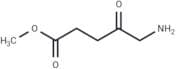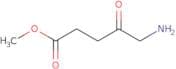
CAS 33320-16-0
:Methyl aminolevulinate
Description:
Methyl aminolevulinate (MAL) is a synthetic compound that serves as a photosensitizer in photodynamic therapy, particularly for the treatment of certain skin conditions, including actinic keratosis. It is an ester derivative of aminolevulinic acid and is characterized by its ability to absorb light in the visible spectrum, leading to the generation of reactive oxygen species upon illumination. This property is crucial for its therapeutic efficacy, as it selectively targets and destroys abnormal cells. MAL is typically administered topically and is known for its relatively low toxicity compared to other photosensitizers. The compound is soluble in organic solvents and has a moderate molecular weight. Its chemical structure includes a methyl group, which enhances its lipophilicity, facilitating skin penetration. In clinical applications, MAL is often used in conjunction with specific light sources to activate its photosensitizing properties, making it a valuable tool in dermatological treatments. Overall, methyl aminolevulinate exemplifies the intersection of chemistry and medicine, showcasing how chemical properties can be harnessed for therapeutic purposes.
Formula:C6H11NO3
InChI:InChI=1S/C6H11NO3/c1-10-6(9)3-2-5(8)4-7/h2-4,7H2,1H3
InChI key:InChIKey=YUUAYBAIHCDHHD-UHFFFAOYSA-N
SMILES:C(CCC(OC)=O)(CN)=O
Synonyms:- Aminolevulinic acid methyl ester
- 5-Aminolevulinic acid methyl ester
- Pentanoic acid, 5-amino-4-oxo-, methyl ester
- Levulinic acid, 5-amino-, methyl ester
- Methyl aminolevulinate
Sort by
Purity (%)
0
100
|
0
|
50
|
90
|
95
|
100
Found 2 products.
Methyl aminolevulinate
CAS:Methyl aminolevulinate, a prodrug for protoporphyrin IX, sensitizes in PDT.Formula:C6H11NO3Purity:98%Color and Shape:SolidMolecular weight:145.16Methyl aminolevulinate
CAS:Methyl aminolevulinate is a photodynamic drug used in the treatment of skin cancer. It is activated by light, which generates singlet oxygen that damages DNA and other cellular components. Methyl aminolevulinate has been shown to be effective as a treatment for actinic keratoses, Bowen's disease, and squamous cell carcinoma. This drug also has anti-inflammatory properties and can help reduce the size of lesions in vivo in humans.Formula:C6H11NO3Purity:Min. 95%Color and Shape:PowderMolecular weight:145.16 g/mol