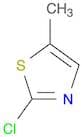
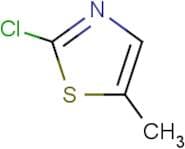
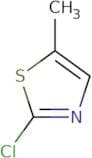
CAS 33342-65-3
:2-Chloro-5-Methylthiazole
Description:
2-Chloro-5-methylthiazole is a heterocyclic organic compound characterized by the presence of both chlorine and a methyl group attached to a thiazole ring. The thiazole ring consists of a five-membered structure containing both sulfur and nitrogen atoms, which contributes to its unique chemical properties. This compound typically appears as a colorless to pale yellow liquid or solid, depending on its physical state at room temperature. It is known for its moderate solubility in polar solvents and limited solubility in non-polar solvents. 2-Chloro-5-methylthiazole exhibits reactivity typical of halogenated compounds, making it useful in various chemical syntheses and applications, including agrochemicals and pharmaceuticals. Its structure allows for potential interactions with biological systems, which can be leveraged in medicinal chemistry. Safety data indicates that it should be handled with care due to potential toxicity and environmental impact. Overall, 2-Chloro-5-methylthiazole is a valuable compound in organic synthesis and research.
Formula:C4H4ClNS
InChI:InChI=1/C4H4ClNS/c1-3-2-6-4(5)7-3/h2H,1H3
SMILES:Cc1cnc(Cl)s1
Sort by
Purity (%)
0
100
|
0
|
50
|
90
|
95
|
100
Found 4 products.
Thiazole, 2-chloro-5-methyl-
CAS:Formula:C4H4ClNSPurity:97%Color and Shape:LiquidMolecular weight:133.59932-Chloro-5-methylthiazole
CAS:Formula:C4H4ClNSPurity:95%Color and Shape:LiquidMolecular weight:133.592-Chloro-5-methylthiazole
CAS:2-Chloro-5-methylthiazole is a chlorinating agent that can be used to synthesize organic compounds. It is prepared by the reaction of triethylamine solution and acetonitrile in the presence of hydrochloric acid and hexane. The synthesis temperature should be kept below -10°C. The product is isolated by filtration, washed with diluent (e.g., isopropyl), and dried under vacuum. 2-Chloro-5-methylthiazole reacts with chloride to produce chlorine gas, which can then be purified using a solution of hydrochloric acid in hexane or methylthiazole in acetonitrile. 2-Chloro-5-methylthiazole can also react with sodium metal in an ethereal solution to produce methylene chloride, which is then reacted with ammonia to form methylamine.Formula:C4H4ClNSPurity:Min. 95%Molecular weight:133.6 g/mol