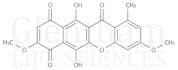
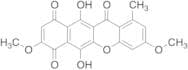
CAS 33390-21-5
:Bikaverin
Description:
Bikaverin is a natural pigment belonging to the class of compounds known as polyketides, specifically produced by certain species of fungi, such as the genus *Bikaveria*. It is characterized by its vibrant red to orange color, which is attributed to its conjugated double bond system that allows for effective light absorption. This compound exhibits a range of biological activities, including antimicrobial and antifungal properties, making it of interest in both pharmaceutical and agricultural applications. Chemically, bikaverin is a complex molecule with a unique structure that contributes to its reactivity and interaction with biological systems. Its potential uses extend to food coloring and as a natural dye due to its stability and safety profile. Additionally, bikaverin's production can be influenced by environmental factors, such as nutrient availability and growth conditions, which can affect its yield and properties. Overall, bikaverin represents a fascinating example of how natural products can offer valuable insights and applications in various fields.
Formula:C20H14O8
InChI:InChI=1S/C20H14O8/c1-7-4-8(26-2)5-10-12(7)17(23)15-18(24)13-9(21)6-11(27-3)16(22)14(13)19(25)20(15)28-10/h4-6,24-25H,1-3H3
InChI key:InChIKey=ZOQMSOSJEWBMHP-UHFFFAOYSA-N
SMILES:OC1=C2C(=C(O)C3=C1C(=O)C=C(OC)C3=O)OC=4C(C2=O)=C(C)C=C(OC)C4
Synonyms:- 10H-benzo[b]xanthene-7,10,12-trione, 6,11-dihydroxy-3,8-dimethoxy-1-methyl-
- Bikaverin
- Lycopersin
- NSC 215139
- 6,11-Dihydroxy-3,8-dimethoxy-1-methyl-10H-benzo[b]xanthene-7,10,12-trione
- 6,11-Dihydroxy-3,8-dimethoxy-1-methyl-10H-benzo[b]xanthene-7,10,12-trione
Sort by
Purity (%)
0
100
|
0
|
50
|
90
|
95
|
100