CAS 334-50-9
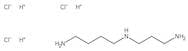
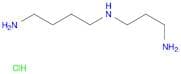
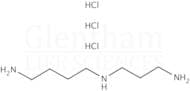
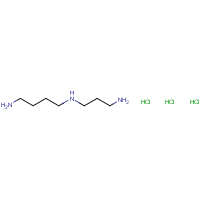
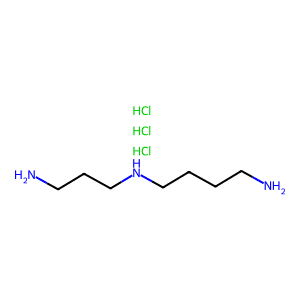
:Spermidine trihydrochloride
Description:
Spermidine trihydrochloride is a polyamine compound that plays a crucial role in cellular processes, including cell growth, proliferation, and differentiation. It is a derivative of spermidine, which is naturally found in all living cells and is involved in various biological functions, such as stabilizing DNA and RNA structures. The trihydrochloride form indicates that the compound is associated with three hydrochloride ions, enhancing its solubility in water and making it suitable for various biochemical applications. Spermidine trihydrochloride is often used in research settings, particularly in studies related to aging, autophagy, and cellular metabolism. Its properties include being a colorless to white crystalline solid, with a relatively high melting point. The compound is typically handled with care due to its biological activity and potential effects on cellular processes. As with many polyamines, it may exhibit a range of physiological effects, including promoting cell growth and influencing gene expression.
Formula:C7H19N3·3ClH
InChI:InChI=1S/C7H19N3.3ClH/c8-4-1-2-6-10-7-3-5-9;;;/h10H,1-9H2;3*1H
InChI key:InChIKey=LCNBIHVSOPXFMR-UHFFFAOYSA-N
SMILES:C(NCCCN)CCCN.Cl
Synonyms:- 1,4-Butanediamine, N-(3-aminopropyl)-, trihydrochloride
- 1,4-Butanediamine, N<sup>1</sup>-(3-aminopropyl)-, hydrochloride (1:3)
- 1,4-Butanediamine, N~1~-(3-aminopropyl)-, hydrochloride (1:3)
- N-(3-aminopropyl)-1,4-butanediamine, trihydrochloride
- Spermidine hydrochloride
- Spermidine trihydrochloride
- N-(3-Aminopropyl)butane-1,4-diamine trihydrochloride
- 1,4-Butanediamine, N1-(3-aminopropyl)-, hydrochloride (1:3)
Sort by
Purity (%)
0
100
|
0
|
50
|
90
|
95
|
100
Found 12 products.
Spermidine trihydrochloride, 99+%
CAS:Binds and precipitates DNA; may be used for purification of DNA binding proteinsFormula:C7H22Cl3N3Purity:99+%Color and Shape:White, Crystals or crystalline powderMolecular weight:254.62Spermidine trihydrochloride
CAS:Formula:C7H22Cl3N3Purity:%Color and Shape:SolidMolecular weight:254.6287Spermidine trihydrochloride
CAS:Formula:C7H19N3·3HClPurity:99.0 - 101.0 %Color and Shape:White to almost white crystalline powderMolecular weight:254.63Spermidine trihydrochloride 100 µg/mL in Acetonitrile:Water
CAS:Formula:C7H19N3ClHColor and Shape:Single SolutionMolecular weight:254.63Spermidine trihydrochloride
CAS:Spermidine trihydrochloride (4-Azaoctamethylenediamine trihydrochloride), a natural polyamine, is a novel autophagy inducer and negatively modulates NMDA.Formula:C7H22Cl3N3Purity:99.90%Color and Shape:White Crystalline PowderMolecular weight:254.62Spermidine Trihydrochloride
CAS:Controlled ProductApplications Spermidine Trihydrochloride is a NOS1 inhibitor and NMDA and T4 activator. Spermidine Trihydrochloride was in a structural and functional study of polyamines, where potassium and sodium ions were found to promote different effects when binding with polyamines.
References Nishio, T., et al.: PloS One, 15, se0238447 (2020)Formula:C7H19N3·3ClHColor and Shape:NeatMolecular weight:254.63Spermidine trihydrochloride
CAS:Spermidine is a naturally occurring polyamine that has been shown to be essential for cell growth and proliferation. It can be found in a variety of foods, such as soybeans, mushrooms, and seafood. Spermidine is also present in human plasma. However, the concentration varies widely between individuals. Spermidine has been shown to act as an effective inhibitor of human osteosarcoma cells by binding to the polymerase chain reaction (PCR) matrix and slowing down the rate of DNA synthesis. Spermidine trihydrochloride (SPDC) is a derivative of spermidine that has been shown to have higher anti-cancer potential than its parent molecule in vitro and in vivo. The compound has been shown to induce autophagy by regulating the expression of genes related to energy metabolism and transcriptional regulation. SPDC may also induce programmed cell death by hydrogen bonding interactions with certain amino acids on the protein matrix. SPDC has also been shownFormula:C7H19N3·3HClColor and Shape:White PowderMolecular weight:254.63 g/molSpermidine trihydrochloride
CAS:Spermidine trihydrochloride is a nitric oxide synthase regulator.
Formula:C7H22Cl3N3Molecular weight:254.63 g/molRef: 3D-S-7320
Discontinued product