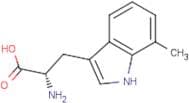
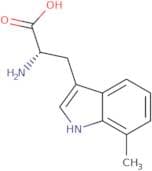
CAS 33468-36-9
:7-methyltryptophan
Description:
7-Methyltryptophan is an indole derivative and an analog of the amino acid tryptophan, characterized by the presence of a methyl group at the 7-position of the indole ring. This compound is notable for its role in various biochemical processes, including its potential involvement in the modulation of serotonin pathways and its influence on neurotransmitter synthesis. It exhibits properties typical of tryptophan derivatives, such as being a precursor to bioactive compounds and having potential implications in neuropharmacology and metabolic studies. 7-Methyltryptophan is soluble in organic solvents and may exhibit varying solubility in water, depending on the pH and other conditions. Its molecular structure contributes to its biological activity, and it has been studied for its effects on cellular processes and its potential therapeutic applications. As with many tryptophan derivatives, it may also play a role in the regulation of sleep, mood, and immune responses. However, further research is necessary to fully elucidate its mechanisms of action and potential benefits in health and disease.
Formula:C12H14N2O2
InChI:InChI=1/C12H14N2O2/c1-7-3-2-4-9-8(6-14-11(7)9)5-10(13)12(15)16/h2-4,6,10,14H,5,13H2,1H3,(H,15,16)
SMILES:Cc1cccc2c(CC(C(=O)O)N)c[nH]c12
Synonyms:- Tryptophan, 7-Methyl-
- 7-Methyl-L-tryptophan
Sort by
Purity (%)
0
100
|
0
|
50
|
90
|
95
|
100
Found 3 products.
(S)-2-Amino-3-(7-methyl-1H-indol-3-yl)propanoic acid
CAS:Formula:C12H14N2O2Purity:97%Color and Shape:Solid, No data available.Molecular weight:218.2567-Methyl-L-tryptophan
CAS:<p>7-Methyl-L-tryptophan (7MT) is a precursor of serotonin. It has been shown that 7MT can be converted to serotonin in vivo and is an intermediate in the biosynthesis of serotonin. 7MT is also a competitive inhibitor of tryptophan's transferase, which converts tryptophan to 7MT. The kinetics of the conversion of tryptophan to 7MT have been studied in olivasterospora erythraea and kinetic data collected. Reaction products were analyzed by thin layer chromatography and gas chromatography. Data show that prenyl groups on the molecule are important for the activation energy required for the formation of 7MT, as well as its hydrophobic nature. The presence or absence of substituents on the aromatic ring affects its hydrophobic interactions with other molecules.</p>Formula:C12H14N2O2Purity:Min. 95%Color and Shape:PowderMolecular weight:218.25 g/mol