CAS 33948-36-6
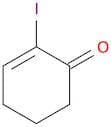
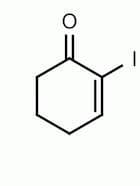
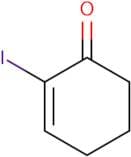
:2-Iodo-2-cyclohexen-1-one
Description:
2-Iodo-2-cyclohexen-1-one is an organic compound characterized by its unique structure, which includes a cyclohexene ring and an iodine substituent. This compound features a carbonyl group (C=O) adjacent to the double bond, contributing to its reactivity and potential applications in organic synthesis. The presence of the iodine atom enhances its electrophilic character, making it useful in various chemical reactions, such as nucleophilic substitutions and coupling reactions. Typically, 2-Iodo-2-cyclohexen-1-one is a colorless to pale yellow liquid or solid, depending on its purity and form. It is soluble in organic solvents, which facilitates its use in laboratory settings. The compound's reactivity is influenced by the electron-withdrawing nature of the carbonyl group and the halogen, making it a valuable intermediate in the synthesis of more complex organic molecules. Safety precautions should be taken when handling this compound, as it may pose health risks due to the presence of iodine and its potential reactivity.
Formula:C6H7IO
InChI:InChI=1S/C6H7IO/c7-5-3-1-2-4-6(5)8/h3H,1-2,4H2
InChI key:InChIKey=IPFSJCDRYRZTJU-UHFFFAOYSA-N
SMILES:IC=1C(=O)CCCC1
Synonyms:- 2-Iodo-2-cyclohexen-1-one
- 2-Iodo-2-cyclohexenone
- 2-Cyclohexen-1-one, 2-iodo-
- 2-Iodocyclohex-2-en-1-one
- 2-iodocyclohex-2-enone
- 2-Benzylsulfanyl-4,5-dihydrothiazole
Sort by
Purity (%)
0
100
|
0
|
50
|
90
|
95
|
100
Found 3 products.
2-Iodocyclohex-2-en-1-one
CAS:2-Iodocyclohex-2-en-1-one is a ligand that undergoes dehydrogenation to form the cyclopentane ring. It reacts with azides to form cyclic compounds and it has been used as a reactive intermediate in cross-coupling reactions. 2-Iodocyclohex-2-en-1-one is also used as a building block for the synthesis of trisubstituted carbonyl compounds, which are important intermediates in organic chemistry. This chemical can be recrystallized from diethyl ether or purified by chromatography.
Formula:C6H7IOPurity:Min. 95%Molecular weight:222.02 g/mol