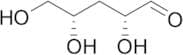
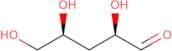
CAS 3396-73-4
:D-erythro-Pentose,3-deoxy-
Description:
D-erythro-Pentose, 3-deoxy- is a sugar derivative characterized by its five-carbon backbone and the absence of a hydroxyl group at the third carbon position, which distinguishes it from other pentoses. This compound is a member of the pentose family, specifically a deoxy sugar, meaning it has one less oxygen atom than its corresponding sugar. It typically exists in a cyclic form, often as a furanose, and can participate in various biochemical reactions, including those involving nucleic acids and metabolic pathways. The absence of the hydroxyl group at the third carbon affects its reactivity and interactions with enzymes and other biomolecules. D-erythro-Pentose, 3-deoxy- is of interest in biochemical research and may have applications in the synthesis of nucleosides or as a building block in the development of pharmaceuticals. Its CAS number, 3396-73-4, allows for easy identification in chemical databases and literature.
Formula:C5H10O4
Synonyms:- 3-Deoxy-D-erythro-pentose
- Cordycepose
- D-Cordysepose
Sort by
Purity (%)
0
100
|
0
|
50
|
90
|
95
|
100
Found 2 products.
3-Deoxy-D-ribose
CAS:Controlled ProductFormula:C5H10O4Color and Shape:NeatMolecular weight:134.057913-Deoxy-D-ribose
CAS:3-Deoxy-D-ribose is a monosaccharide with a molecular formula of CH(OH)CO. It is the 3-deoxy form of ribose and its pyranose ring has an oxygen atom at the 3 position. 3-Deoxy-D-ribose can be synthesized by periodate treatment of glyceric acid in the presence of hydrochloric acid, followed by hydrolysis to produce sorbose and then reaction with glycolaldehyde to produce D-glycero-D-galactopyranosyl bromide. The final step is conversion to 3-deoxyribose by reaction with aqueous ammonia. 3-Deoxyribose inhibits ribulose synthesis, which prevents the formation of an intermediate molecule required for the synthesis of fatty acids and phospholipids.Purity:Min. 95%