

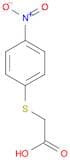
![[(4-nitrophenyl)sulfanyl]acetic acid](/_next/image/?url=https%3A%2Fstatic.cymitquimica.com%2Fcas-image%2Fthumb-webp%2F157410-4-nitrophenyl-sulfanyl-acetic-acid.webp&w=3840&q=75)
CAS 3406-75-5
:[(4-nitrophenyl)sulfanyl]acetic acid
Description:
[(4-Nitrophenyl)sulfanyl]acetic acid, with the CAS number 3406-75-5, is an organic compound characterized by the presence of both a nitrophenyl group and a sulfanyl (thio) group attached to an acetic acid moiety. This compound typically appears as a solid at room temperature and is soluble in polar solvents due to the presence of the carboxylic acid functional group. The nitro group contributes to its electron-withdrawing properties, which can influence its reactivity and interactions in chemical reactions. The sulfanyl group introduces sulfur into the structure, which can participate in various chemical transformations, including nucleophilic substitutions. This compound may exhibit biological activity, making it of interest in medicinal chemistry and research applications. Its properties, such as melting point, boiling point, and specific reactivity, can vary based on the purity and specific conditions under which it is handled. Safety precautions should be observed when working with this compound, as it may pose health risks due to the presence of the nitro group.
Formula:C8H7NO4S
InChI:InChI=1/C8H7NO4S/c10-8(11)5-14-7-3-1-6(2-4-7)9(12)13/h1-4H,5H2,(H,10,11)
SMILES:c1cc(ccc1N(=O)=O)SCC(=O)O
Synonyms:- Acetic Acid, 2-[(4-Nitrophenyl)Thio]-
Sort by
Purity (%)
0
100
|
0
|
50
|
90
|
95
|
100
Found 4 products.
[(4-Nitrophenyl)sulphanyl]acetic acid
CAS:[(4-Nitrophenyl)sulphanyl]acetic acid
Formula:C8H7NO4SPurity:95+% (Typical Value in Batch COA)Color and Shape: solidMolecular weight:213.21g/mol2-[(4-Nitrophenyl)sulfanyl]acetic acid
CAS:2-[(4-Nitrophenyl)sulfanyl]acetic acid is a colorless liquid with a boiling point of 168°C. It is soluble in water, glycol, and ether, but not in ethanol. 2-[(4-Nitrophenyl)sulfanyl]acetic acid has been shown to be an acceptor for borate, forming the perborate ion. It also reacts with glycol to form the glyoxalate ion. The compound has been shown to react with nitric acid and ethylene glycol to form nitroethane and acetic acid molecules. This reaction is catalyzed by hydrogen bonding between the oxygen atoms of acetic acid and nitric acid, which causes an electron transfer from nitric acid to acetic acid molecules. This process results in reactive species that can then react with other substances such as hydrogen bonds or peracetic acid.Formula:C8H7NO4SPurity:Min. 95%Molecular weight:213.21 g/mol

![[(4-Nitrophenyl)sulphanyl]acetic acid](/_next/image/?url=https%3A%2Fstatic.cymitquimica.com%2Fproducts%2F54%2Fthumb%2FOR14293.jpg&w=3840&q=75)

![2-[(4-Nitrophenyl)sulfanyl]acetic acid](/_next/image/?url=https%3A%2Fstatic.cymitquimica.com%2Fproducts%2F10%2Fthumb%2FF636126.jpg&w=3840&q=75)

![2-[(4-Nitrophenyl)sulfanyl]acetic acid](/_next/image/?url=https%3A%2Fstatic.cymitquimica.com%2Fproducts%2F3D%2Fthumb%2FDAA40675.jpg&w=3840&q=75)
