CAS 3418-45-9
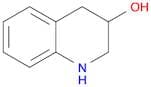
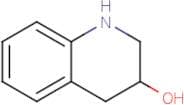
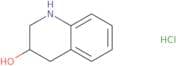
:1,2,3,4-tetrahydroquinolin-3-ol
Description:
1,2,3,4-Tetrahydroquinolin-3-ol is a bicyclic organic compound characterized by a fused ring structure that includes a quinoline moiety. It features a hydroxyl group (-OH) at the 3-position of the tetrahydroquinoline framework, which contributes to its chemical reactivity and potential biological activity. This compound is typically a colorless to pale yellow liquid or solid, depending on its purity and form. It is soluble in organic solvents and exhibits moderate polarity due to the presence of the hydroxyl group. The compound is of interest in medicinal chemistry, as it may exhibit various pharmacological properties, including potential neuroprotective and anti-inflammatory effects. Its structure allows for various chemical modifications, which can enhance its biological activity or alter its physicochemical properties. Safety data indicates that, like many organic compounds, it should be handled with care, as it may pose health risks if ingested or inhaled. Overall, 1,2,3,4-tetrahydroquinolin-3-ol is a compound with significant potential in research and development within the pharmaceutical field.
Formula:C9H11NO
InChI:InChI=1/C9H11NO/c11-8-5-7-3-1-2-4-9(7)10-6-8/h1-4,8,10-11H,5-6H2
SMILES:c1ccc2c(c1)CC(CN2)O
Synonyms:- 1,2,3,4-Tetrahydrochinolin-3-ol
Sort by
Purity (%)
0
100
|
0
|
50
|
90
|
95
|
100
Found 4 products.
3-Quinolinol, 1,2,3,4-tetrahydro-
CAS:Formula:C9H11NOPurity:96%Color and Shape:SolidMolecular weight:149.18971,2,3,4-Tetrahydroquinolin-3-ol
CAS:1,2,3,4-Tetrahydroquinolin-3-olPurity:96%Molecular weight:149.19g/mol1,2,3,4-Tetrahydroquinolin-3-ol
CAS:1,2,3,4-Tetrahydroquinolin-3-ol is a stabilizer that can be used to prevent or slow down the polymerization of epoxy resins. It can also be used as an intermediate in the synthesis of other organic compounds. 1,2,3,4-Tetrahydroquinolin-3-ol has been shown to react with amines and nucleophiles to form new compounds. It has also been shown to stabilize proton transfer reactions. This compound is also capable of reacting with inorganic acids to form ring-opening polymers.
Formula:C9H11NOPurity:Min. 95%Molecular weight:149.19 g/mol