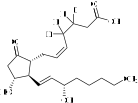
CAS 34210-10-1
:Prosta-5,13-dien-3,3,4,4-d4-1-oicacid, 11,15-dihydroxy-9-oxo-, (5Z,11a,13E,15S)-
Description:
Prosta-5,13-dien-3,3,4,4-d4-1-oic acid, 11,15-dihydroxy-9-oxo-, (5Z,11a,13E,15S)-, with CAS number 34210-10-1, is a synthetic derivative of prostaglandins, which are bioactive lipids involved in various physiological processes. This compound features a complex structure characterized by multiple functional groups, including hydroxyl (-OH) groups and a ketone (C=O), contributing to its biological activity. The presence of deuterium atoms (d4) indicates isotopic labeling, which can be useful in tracing metabolic pathways or studying pharmacokinetics. The stereochemistry denoted by the (5Z,11a,13E,15S) configuration suggests specific spatial arrangements of atoms, which are crucial for the compound's interaction with biological targets, such as receptors or enzymes. Prostaglandin derivatives are known for their roles in inflammation, pain modulation, and regulation of various physiological functions, making this compound potentially significant in pharmaceutical research and therapeutic applications. However, detailed studies would be necessary to fully elucidate its biological effects and potential uses.
Formula:C20H28D4O5
Synonyms:- 5-Heptenoic-3,3,4,4-d4acid, 7-[3-hydroxy-2-(3-hydroxy-1-octenyl)-5-oxocyclopentyl]-, stereoisomer(8CI)
- Prostaglandin E2-3,3,4,4-d4
Sort by
Purity (%)
0
100
|
0
|
50
|
90
|
95
|
100
Found 3 products.
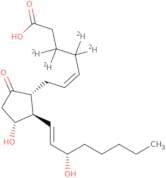
Prostaglandin E2-d4
CAS:Controlled Product<p>Applications Labelled analogue of Prostaglandin E2. The most common and most biologically potent of mammalian prostaglandins. Isolated from sheep prostate. Oxytocic; abortifacient.<br>References Van Dorp, D.A. et al.: Biochem. Biopphys. Acta, 90, 204 (1964); Hamberg, M. et al.: J. Biol. Chem., 246, 6713 (1971);<br></p>Formula:C20H28D4O5Color and Shape:NeatMolecular weight:356.50Prostaglandin E2-d4
CAS:Controlled Product<p>Prostaglandin E2-d4 is a fatty acid that acts as an inflammatory mediator. It is structurally similar to prostaglandin E2 and has been shown to have similar effects on disease activity and fetal bovine growth. Prostaglandin E2-d4 has been detected in the blood of deficient mice, although its role in the development of this disease is not clear. The analytical method used for measuring prostaglandin E2-d4 levels is based on gas chromatography coupled with mass spectrometry and allows for accurate measurements at physiological levels. This substance may be a potential biomarker for diagnosing diseases such as diabetes mellitus type II, insulin sensitivity, and cardiovascular diseases.</p>Formula:C20H28D4O5Purity:Min. 95%Molecular weight:356.49 g/mol