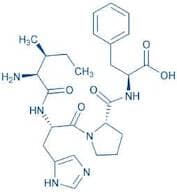
![L-Phenylalanine, N-[1-(N-L-isoleucyl-L-histidyl)-L-prolyl]-](/_next/image/?url=https%3A%2Fstatic.cymitquimica.com%2Fcas-image%2Fthumb-webp%2F302707-l-phenylalanine-n-1-n-l-isoleucyl-l-histidyl-l-prolyl.webp&w=3840&q=75)
CAS 34233-50-6
:L-Phenylalanine, N-[1-(N-L-isoleucyl-L-histidyl)-L-prolyl]-
Description:
L-Phenylalanine, N-[1-(N-L-isoleucyl-L-histidyl)-L-prolyl]- is a peptide compound that consists of a phenylalanine residue linked to a sequence of amino acids, including isoleucine, histidine, and proline. This compound is characterized by its specific amino acid composition, which contributes to its unique properties and potential biological activities. Peptides like this one often exhibit various functions in biological systems, including roles in signaling, enzyme activity, and as precursors to larger proteins. The presence of aromatic amino acids, such as phenylalanine, can influence the compound's hydrophobicity and interaction with other biomolecules. Additionally, the specific sequence and structure of the peptide can affect its stability, solubility, and reactivity. As a result, L-Phenylalanine, N-[1-(N-L-isoleucyl-L-histidyl)-L-prolyl]- may have applications in pharmaceuticals, nutrition, and biochemistry, although further research would be necessary to fully elucidate its properties and potential uses.
Formula:C26H36N6O5
Sort by
Purity (%)
0
100
|
0
|
50
|
90
|
95
|
100
Found 3 products.
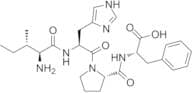
Angiotensin I/II (5-8)
CAS:Bachem ID: 4030363.
Formula:C26H36N6O5Color and Shape:WhiteMolecular weight:512.61Angiotensin II (5-8), human
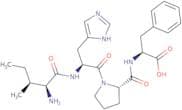
CAS:Angiotensin II (5-8) is an endogenous C-terminal fragment of the peptide vasoconstrictor angiotensin IIFormula:C26H36N6O5Purity:98%Color and Shape:SolidMolecular weight:512.6Angiotensin I/II (5-8) TFA salt
CAS:Angiotensin I/II (5-8) H-Ile-His-Pro-Phe-OH is a tetrapeptide that is an endogenous opioid. It has been shown to be involved in the modulation of blood pressure and in the regulation of intestinal and mesencephalic functions. In addition, it has been found to be a modulator of nonselective cation channels, which are responsible for muscle contraction. Angiotensin I/II (5-8) H-Ile-His-Pro-Phe-OH has a dose dependent effect on the activation of opioid receptors, which can lead to analgesia. This peptide is also inactivated by proteolytic enzymes such as dipeptidyl peptidase IV and aminopeptidase N.Formula:C26H36N6O5•xC2HF3O2Purity:Min. 95%Molecular weight:512.6 g/mol