CAS 34346-01-5
:Poly(lactic-co-glycolic acid)
Description:
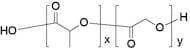
Poly(lactic-co-glycolic acid) (PLGA) is a biodegradable copolymer composed of lactic acid and glycolic acid monomers. It is characterized by its biocompatibility, making it suitable for various biomedical applications, including drug delivery systems, tissue engineering, and sutures. PLGA's properties can be tailored by adjusting the ratio of lactic to glycolic acid, which influences its degradation rate and mechanical strength. Typically, PLGA exhibits a glass transition temperature that allows it to remain flexible at physiological temperatures. The degradation of PLGA occurs through hydrolysis, leading to the gradual release of the encapsulated drugs or the breakdown of the polymer into non-toxic byproducts, primarily lactic and glycolic acids, which are naturally metabolized by the body. Additionally, PLGA can be processed into various forms, such as microspheres, films, and scaffolds, enhancing its versatility in medical applications. Its FDA approval for use in medical devices further underscores its safety and efficacy in clinical settings.
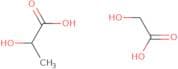
Formula:(C3H6O3·C2H4O3)x
InChI:InChI=1S/C3H6O3.C2H4O3/c1-2(4)3(5)6;3-1-2(4)5/h2,4H,1H3,(H,5,6);3H,1H2,(H,4,5)
InChI key:InChIKey=XBBVURRQGJPTHH-UHFFFAOYSA-N
SMILES:C(CO)(O)=O.C(C(O)=O)(C)O
Synonyms:- (.+-.)-2-Hydroxypropanoic acid-hydroxyacetic acid copolymer
- 2-Hydroxyacetic acid-lactic acid copolymer
- 85Dg065
- <span class="text-smallcaps">D</smallcap><smallcap>L</span>-Lactic acid-glycolic acid copolymer
- Acetic acid, hydroxy-, polymer with 2-hydroxypropanoic acid
- Alzamer Depot
- B 6006-1P
- Expansorb DLG 50-2A
- GC-Membrane
- Glycolic acid-<span class="text-smallcaps">D</smallcap><smallcap>L</span>-lactic acid copolymer
- Glycolic acid-DL-lactic acid copolymer
- Glycolic acid-lactic acid copolymer
- Glycolic acid-lactic acid polymer
- Glycolic acid-lactid acid copolymer
- Hydroxyacetic acid-(.+-.)-2-hydroxypropanoic acid copolymer
- Hydroxyacetic acid-2-hydroxypropionic acid copolymer
- Hydroxyacetic acid-lactic acid copolymer
- Lactel BP 400
- Lactic acid-glycolic acid copolymer
- Lactic acid-glycolic acid polymer
- Lactic acid-hydroxyacetic acid copolymer
- Lg 80
- Lg 855S
- M 700 (polyester)
- Medisorb 5050DL1A
- P 134386-1G
- Plga 5-1
- Plga 5-50
- Plga 5005
- Plga 5010
- Plga 5015
- Plga 5020
- Plga 75-65
- Plga 7505
- Plga 7510
- Plga 7515
- Plga 7520
- Plga 7525
- Plga 7525-4A
- Plga 7525-5A
- Poly(<span class="text-smallcaps">D</smallcap><smallcap>L</span>-lactic acid-co-glycolic acid)
- Poly(<span class="text-smallcaps">D</smallcap><smallcap>L</span>-lactic acid-glycolic acid)
- Poly(<span class="text-smallcaps">D</smallcap><smallcap>L</span>-lactic-co-glycolic acid)
- Poly(DL-lactic acid-glycolic acid)
- Poly(d,l-lactic-co-glycolic acid)
- Poly(glycolic acid-co-<span class="text-smallcaps">D</smallcap><smallcap>L</span>-lactic acid)
- Poly(glycolic acid-co-DL-lactic acid)
- Poly(glycolic acid-lactic acid)
- Poly(lactic acid-co-glycolic acid)
- Poly(lactic acid-glycolic acid)
- Poly(lactic acid-hydroxyacetic acid) copolymer
- Poly(lactic-co-glycolic acid)
- Polylactic acid-glycolic acid copolymer
- Polylactoglycolidic acid
- Propanoic acid, 2-hydroxy-, polymer with 2-hydroxyacetic acid
- Purasorb PDLG 5002
- Purasorb PDLG 5002A
- Purasorb PLG 8531
- Resolut
- Resolut LT
- Resolut ST
- Resomer 753S
- Resomer LG 824S
- Resomer LG 855S
- Resomer RG 756S
- Resomer RG 858
- dl-Lactic acid-glycolic acid copolymer
- dl-Lactic acid-glycolic acid polymer
- See more synonyms
Sort by
Purity (%)
0
100
|
0
|
50
|
90
|
95
|
100
Found 4 products.
PLGA 75:25 DLLAGA 2A (Poly(DL-lactic acid-co-glycolic acid) acid terminated (75:25))
CAS:Polyesters, saturated, in primary forms, nesoiFormula:HC3H4O2nC2H2O2mOHColor and Shape:White PowderMolecular weight:4.000-15.000 DaPLGA
CAS:PLGA (poly(lactic-co-glycolic acid)) is be used to fabricate devices for drug delivery and tissue engineering applications.Formula:(C3H6O3·C2H4O3)xPurity:50:50 - 50:50Color and Shape:SolidMolecular weight:166.129PLGA
CAS:PLGA is a biocompatible polymer that is used in the manufacture of implantable medical devices. It is also used as an injection solution and has significant cytotoxicity. PLGA has been shown to be effective in vivo in animal models with breast cancer, hypoglycemia, and bone-disease implants. In vitro studies have confirmed its efficacy as a delivery vehicle for growth factor-β1. Furthermore, PLGA nanoparticles are being investigated as a drug-delivery system for radiation therapy.Formula:(C3H6O3)n•(C2H4O3)nPurity:Min 98%Color and Shape:PowderPLGA(50:50)
CAS:Please enquire for more information about PLGA(50:50) including the price, delivery time and more detailed product information at the technical inquiry form on this pageFormula:(C3H6O3•C2H4O3)x