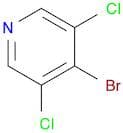
CAS 343781-45-3
:4-Bromo-3,5-dichloropyridine
Description:
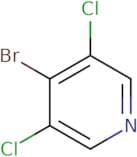
4-Bromo-3,5-dichloropyridine is a heterocyclic organic compound characterized by a pyridine ring substituted with bromine and chlorine atoms. Specifically, it features a bromine atom at the 4-position and two chlorine atoms at the 3 and 5 positions of the pyridine ring. This compound is typically a colorless to pale yellow liquid or solid, depending on its physical state at room temperature. It is known for its applications in the synthesis of pharmaceuticals and agrochemicals, owing to the reactivity of the halogen substituents, which can participate in various chemical reactions such as nucleophilic substitutions. The presence of multiple halogens enhances its biological activity and can influence its solubility and stability. Additionally, 4-Bromo-3,5-dichloropyridine may exhibit specific toxicological properties, necessitating careful handling and storage. As with many halogenated compounds, it is important to consider environmental impacts and regulatory guidelines when working with this substance.
Formula:C5H2BrCl2N
InChI:InChI=1/C5H2BrCl2N/c6-5-3(7)1-9-2-4(5)8/h1-2H
SMILES:c1c(c(c(cn1)Cl)Br)Cl
Synonyms:- Pyridine, 4-Bromo-3,5-Dichloro-
- T6Nj Cg De Eg
- 4-Bromo-3,5-dichloropyridine
Sort by
Purity (%)
0
100
|
0
|
50
|
90
|
95
|
100
Found 4 products.
4-Bromo-3,5-dichloropyridine
CAS:Formula:C5H2BrCl2NPurity:95%Color and Shape:SolidMolecular weight:226.88614-Bromo-3,5-dichloropyridine
CAS:4-Bromo-3,5-dichloropyridineFormula:C5H2BrCl2NPurity:98%Color and Shape:SolidMolecular weight:226.89g/mol4-Bromo-3,5-dichloropyridine
CAS:Formula:C5H2BrCl2NPurity:98%Color and Shape:SolidMolecular weight:226.884-Bromo-3,5-dichloropyridine
CAS:4-Bromo-3,5-dichloropyridine is a reactive intermediate that is used as a reagent in organic synthesis. It has low basicity and reacts with lithium to form the lithium salt. The salt can be deprotonated to form the bromide anion, which is more reactive than the chloride anion. 4-Bromo-3,5-dichloropyridine can also be used for the selective isomerization of ketones and related compounds. Bromine is added to prevent side reactions with oxygen. The intermediates are generated at the site of reaction by using an excess of diisopropylamide over bromination agent.
Formula:C5H2BrCl2NPurity:Min. 95%Molecular weight:226.89 g/mol