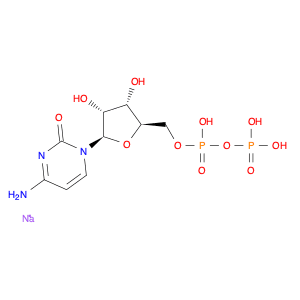
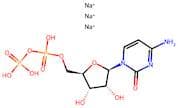
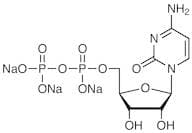
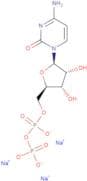
CAS 34393-59-4
:Cytidine 5′-(trihydrogen diphosphate), sodium salt (1:3)
Description:
Cytidine 5′-(trihydrogen diphosphate), sodium salt (1:3), commonly referred to as CDP, is a nucleotide derivative that plays a crucial role in cellular metabolism and biochemistry. It consists of a cytidine base linked to a diphosphate group, which is further associated with sodium ions. This compound is typically involved in the synthesis of RNA and serves as a precursor for the synthesis of other nucleotides. Its structure allows it to participate in various biochemical pathways, including those related to energy transfer and signal transduction. CDP is soluble in water, which facilitates its biological functions in aqueous environments within cells. The sodium salt form enhances its stability and solubility, making it suitable for laboratory and pharmaceutical applications. Additionally, it is important in the regulation of metabolic processes and can act as a substrate for enzymes involved in nucleotide metabolism. Overall, CDP is a vital component in the molecular machinery of life, contributing to the synthesis and regulation of nucleic acids.
Formula:C9H15N3O11P2·3Na
InChI:InChI=1S/C9H15N3O11P2.3Na/c10-5-1-2-12(9(15)11-5)8-7(14)6(13)4(22-8)3-21-25(19,20)23-24(16,17)18;;;/h1-2,4,6-8,13-14H,3H2,(H,19,20)(H2,10,11,15)(H2,16,17,18);;;/t4-,6-,7-,8-;;;/m1.../s1
InChI key:InChIKey=CGVGCZOANPQAQT-LLWADOMFSA-N
SMILES:O[C@H]1[C@@H](O[C@H](COP(OP(=O)(O)O)(=O)O)[C@H]1O)N2C(=O)N=C(N)C=C2.[Na]
Synonyms:- Cytidine 5'-diphosphate,trisodium salt
- Cytidine 5′-(trihydrogen diphosphate), sodium salt (1:3)
- Cytidine 5′-(trihydrogen diphosphate), trisodium salt
- Cytidine 5′-(trihydrogen pyrophosphate), trisodium salt
- Cytidine diphosphate trisodium salt
- Cytidine-5-diphosphate sodium salt
- Cytidine-5-diphosphoric acid trisodium salt = CTP-Na3
- Trisodium cytidine 5′-diphosphate
Sort by
Purity (%)
0
100
|
0
|
50
|
90
|
95
|
100
Found 7 products.
Cytidine 5'-diphosphate (trisodium salt)
CAS:Formula:C9H12N3Na3O11P2Purity:95%Color and Shape:SolidMolecular weight:469.1219Cytidine 5'-diphosphate trisodium salt
CAS:CDP, a trisodium salt, helps synthesize DNA/RNA by aiding phosphoryl transfer from ATP to CMP via UMPK.Formula:C9H15N3Na3O11P2Purity:99.55%Color and Shape:White Crystalline PowderMolecular weight:472.15Cytidine 5'-diphosphate trisodium salt
CAS:Cytidine 5'-diphosphate trisodium saltPurity:≥98%Molecular weight:472.15g/molCytidine 5'-Diphosphate Trisodium Salt
CAS:Formula:C9H12N3Na3O11P2Purity:>95.0%(T)(HPLC)Color and Shape:White to Almost white powder to crystalMolecular weight:469.12Cytidine-5''-diphosphate trisodium salt dihydrate
CAS:Formula:C9H12N3Na3O11P2Purity:≥ 98.0%Color and Shape:Yellow powderMolecular weight:469.12Cytidine-5'-diphosphate trisodium
CAS:Cytidine-5'-diphosphate trisodium (CDP-Tris) is a copolymerization agent that contains a formamide molecule, which is used to increase the viscosity of the polymer. It is also used as a hydrogen bond donor and acceptor in the synthesis of polymers. CDP-Tris can be used for DNA replication and repairs damaged DNA by binding to 7-methylguanine, one of the most common lesions found in DNA. This agent has been shown to be effective in diluting crude cell extracts from E. coli bacteria. CDP-Tris is also used to synthesize polymers with 3-methylcytidine monomers that contain nitrogen atoms. These polymers are then used as substitutes for natural polymers such as cellulose and starch, which can be difficult to process because they are hydrophobic.Formula:C9H12N3Na3O11P2Purity:Min. 95 Area-%Color and Shape:White Yellow PowderMolecular weight:469.12 g/mol