CAS 344-25-2
:D-Proline
Description:
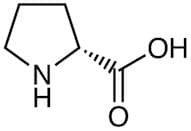
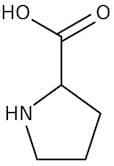
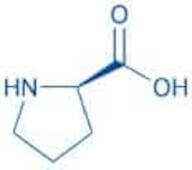
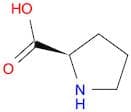
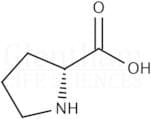
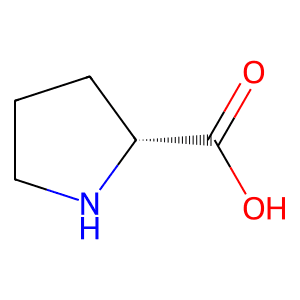
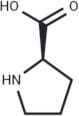
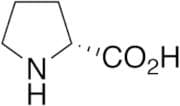
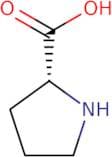
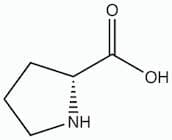
D-Proline is a naturally occurring amino acid classified as a non-essential amino acid, meaning the body can synthesize it. It is characterized by its unique cyclic structure, which includes a five-membered ring formed by the amino group and the side chain, contributing to its distinctive properties. D-Proline is known for its role in protein synthesis and is particularly important in the formation of collagen, a key structural protein in connective tissues. It exhibits a chiral nature, with D-Proline being one of the two enantiomers of proline, the other being L-Proline, which is more commonly found in proteins. D-Proline is soluble in water and has a relatively high melting point compared to other amino acids. Its presence in various biological processes, including cellular signaling and osmoregulation, highlights its significance in biochemistry. Additionally, D-Proline has been studied for its potential therapeutic applications, including its role in neuroprotection and as a precursor in the synthesis of various pharmaceuticals.
Formula:C5H9NO2
InChI:InChI=1S/C5H9NO2/c7-5(8)4-2-1-3-6-4/h4,6H,1-3H2,(H,7,8)/t4-/m1/s1
InChI key:InChIKey=ONIBWKKTOPOVIA-SCSAIBSYSA-N
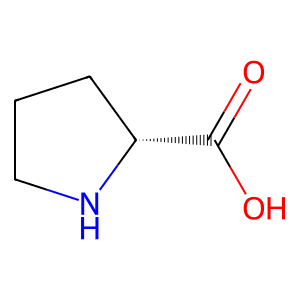
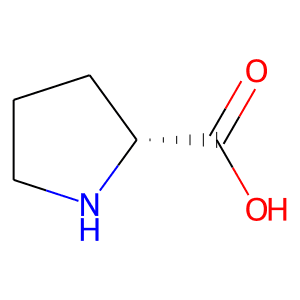
SMILES:C(O)(=O)[C@H]1CCCN1
Synonyms:- (+)-(R)-Proline
- (2R)-Pyrrolidin-1-ium-2-carboxylate
- (2R)-Pyrrolidine-2-carboxylic acid
- (R)-2-Carboxypyrrolidine
- (R)-Pyrrolidine-2-carboxylic acid
- <span class="text-smallcaps">D</span>-(+)-Proline
- D-(+)-Prolin
- D-(+)-prolina
- D-Pyrrolidine-2-carboxylic acid
- H-D-Pro-OH
- Proline, <span class="text-smallcaps">D</span>-
- Proline, D-
- D-Proline
- See more synonyms
Sort by
Purity (%)
0
100
|
0
|
50
|
90
|
95
|
100
Found 15 products.
D-Proline
CAS:Formula:C5H9NO2Purity:>98.0%(T)Color and Shape:White to Almost white powder to crystalMolecular weight:115.13D-Proline, 99%
CAS:D-Proline is an essential component of collagen and is important for proper functioning of joints and tendons. It is also used as asymmetric catalysts in proline organocatalysis reactions. This Thermo Scientific Chemicals brand product was originally part of the Alfa Aesar product portfolio. Some doFormula:C5H9NO2Purity:99%Color and Shape:Crystals or powder or crystalline powder, White to pale creamMolecular weight:115.13H-D-Pro-OH
CAS:Bachem ID: 4031089.
Formula:C5H9NO2Purity:> 99%Color and Shape:WhiteMolecular weight:115.13D-Proline
CAS:Formula:C5H9NO2Purity:98.0 - 101.0 %Color and Shape:White to off-white powderMolecular weight:115.13(R)-pyrrolidine-2-carboxylic acid
CAS:(R)-pyrrolidine-2-carboxylic acid
Purity:≥98%Molecular weight:115.13g/molD-Proline
CAS:D-ProlineFormula:C5H9NO2Purity:98%Color and Shape: faint yellow crystalline needlesMolecular weight:115.13046g/mol(2R)-Pyrrolidine-2-carboxylic acid
CAS:(2R)-Pyrrolidine-2-carboxylic acidFormula:C5H9NO2Purity:≥95%Color and Shape: white to off-white solidMolecular weight:115.13g/mol(R)-pyrrolidine-2-carboxylic acid
CAS:D-Proline, (R)-pyrrolidine-2-carboxylic acid, is L-Proline's isomer, found in human plasma/saliva, possibly from bacteria or racemase activity.Formula:C5H9NO2Purity:99.88%Color and Shape:Flat Needles From Alcohol + Ether; Prisms From Water SolidMolecular weight:115.13D-Proline
CAS:D-Proline is a non-essential amino acid that can be synthesized by the body. It is a racemic mixture of the two stereoisomers, L-proline and D-proline. Research has shown that D-proline inhibits the enzyme racemase, which converts L-proline to D-proline. Racemase inhibition leads to an accumulation of L-proline, which may reduce disease activity in some cases. D-Proline also inhibits liver cells and trigeminal nerve cells, leading to decreased pain. The asymmetric synthesis of picolinic acid from D-pyridoxal 5'-phosphate catalyzed by prolinase occurs at a pH optimum around 2.8. This reaction is used as a model system for studying chemical biology and antimicrobial peptides. D-Proline can be found in E coli K12 and other bacteria with analytical chemistry techniques such as gas chromatography mass spectrometry (GCFormula:C5H9NO2Color and Shape:PowderMolecular weight:115.13 g/molD-Proline extrapure CHR, 99%
CAS:Formula:C5H9NO2Purity:min. 99%Color and Shape:White to off-white, Crystalline powder, Clear, Colourless to faint yellowMolecular weight:115.13