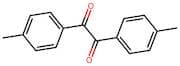
CAS 3457-48-5
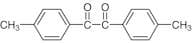
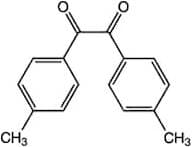
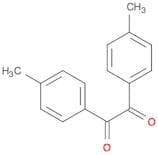
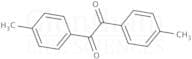
:1,2-Bis(4-methylphenyl)-1,2-ethanedione
Description:
1,2-Bis(4-methylphenyl)-1,2-ethanedione, also known as dibenzoyl methane, is an organic compound characterized by its diketone structure, featuring two 4-methylphenyl groups attached to a central ethanedione moiety. This compound typically appears as a yellow to orange crystalline solid and is known for its ability to absorb ultraviolet light, making it useful in various applications, including as a UV filter in sunscreens and cosmetics. Its molecular structure contributes to its stability and reactivity, allowing it to participate in various chemical reactions, such as condensation and polymerization. The compound is generally soluble in organic solvents like ethanol and acetone but has limited solubility in water. Additionally, it exhibits moderate toxicity, necessitating careful handling in laboratory and industrial settings. Its unique properties and versatility make it a subject of interest in both academic research and commercial applications, particularly in the fields of materials science and photochemistry.
Formula:C16H14O2
InChI:InChI=1S/C16H14O2/c1-11-3-7-13(8-4-11)15(17)16(18)14-9-5-12(2)6-10-14/h3-10H,1-2H3
InChI key:InChIKey=BCWCEHMHCDCJAD-UHFFFAOYSA-N
SMILES:C(C(=O)C1=CC=C(C)C=C1)(=O)C2=CC=C(C)C=C2
Synonyms:- 1,2-Bis(4-Methylphenyl)Ethane-1,2-Dione
- 1,2-Bis(4-methylphenyl)-1,2-ethanedione
- 1,2-Bis(4-methylphenyl)ethanedione
- 1,2-Bis(p-tolyl)ethane-1,2-dione
- 1,2-Di-p-tolylethane-1,2-dione
- 1,2-Ethanedione, 1,2-bis(4-methylphenyl)-
- 4,4'-二甲基苯
- 4,4-二甲基苯偶酰
- Bis(4-methylphenyl)ethanedione
- Di-p-methylbenzil
- Di-p-tolylethanedione
- Ethanedione, bis(4-methylphenyl)-
- NSC 22505
- p,p′-Dimethylbenzil
- p-Tolil
- See more synonyms
Sort by
Purity (%)
0
100
|
0
|
50
|
90
|
95
|
100
Found 7 products.
4,4'-Dimethylbenzil
CAS:Formula:C16H14O2Purity:>99.0%(GC)Color and Shape:Light yellow to Yellow to Green powder to crystalineMolecular weight:238.294,4'-Dimethylbenzil, 98%
CAS:This Thermo Scientific Chemicals brand product was originally part of the Alfa Aesar product portfolio. Some documentation and label information may refer to the legacy brand. The original Alfa Aesar product / item code or SKU reference has not changed as a part of the brand transition to Thermo SciFormula:C16H14O2Purity:98%Color and Shape:Pale yellow to yellow, Crystals or powder or crystalline powderMolecular weight:238.291,2-Di-p-tolylethane-1,2-dione
CAS:Formula:C16H14O2Purity:98%Color and Shape:SolidMolecular weight:238.28121,2-Di-p-tolylethane-1,2-dione
CAS:1,2-Di-p-tolylethane-1,2-dionePurity:98%Molecular weight:238.29g/mol4,4'-Dimethylbenzil
CAS:4,4'-Dimethylbenzol is an organic compound that has been synthesized by irradiating 4,4'-dimethoxybenzil with ultraviolet light. The compound is used in the synthesis of other organic compounds. 4,4'-Dimethylbenzol reacts with lead tetraacetate to form a symmetric phosphorane. This reaction can be used to produce various xanthone derivatives. The elemental analysis of 4,4'-dimethylbenzol shows that it contains one carbon atom and four hydrogen atoms. The ligand in the molecule is benzoin and the nmr spectra show signals for two aromatic protons and one methyl group proton. The metal ions present in this molecule are lead and mercury.
Formula:C16H14O2Purity:Min. 98%Color and Shape:PowderMolecular weight:238.28 g/molRef: 3D-FD66390
Discontinued product