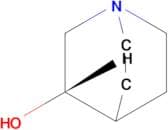
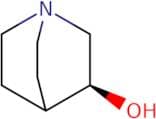
CAS 34583-34-1
:S-(+)-3-Hydroxy quinuclidine
Description:
S-(+)-3-Hydroxy quinuclidine is a chiral compound characterized by its unique bicyclic structure, which is derived from quinuclidine. This substance features a hydroxyl group (-OH) at the 3-position of the quinuclidine framework, contributing to its solubility and reactivity. It is known for its potential applications in medicinal chemistry, particularly as a building block in the synthesis of various pharmaceuticals and as a ligand in asymmetric synthesis. The compound exhibits basic properties due to the presence of a nitrogen atom in its structure, which can participate in hydrogen bonding and coordination with metal ions. Its chirality is significant, as it can exhibit different biological activities depending on the enantiomer. S-(+)-3-Hydroxy quinuclidine is typically handled with care in laboratory settings, adhering to safety protocols due to its chemical reactivity. Overall, its structural features and properties make it a valuable compound in both research and industrial applications.
Formula:C7H13NO
InChI:InChI=1/C7H13NO/c9-7-5-8-3-1-6(7)2-4-8/h6-7,9H,1-5H2/t7-/m1/s1
SMILES:C1CN2CCC1[C@@H](C2)O
Synonyms:- (S)-(+)-3-Hydroxyquinuclidine
- (S)-(+)-3-Quinuclidinol
- (S)-3-Quinuclidinol. Hydrochloride
- (3S)-1-azabicyclo[2.2.2]octan-3-ol
Sort by
Purity (%)
0
100
|
0
|
50
|
90
|
95
|
100
Found 5 products.
(S)-Solifenacin EP Impurity E
CAS:Formula:C7H13NOColor and Shape:White To Off-White SolidMolecular weight:127.19(3S)-1-Azabicyclo[2.2.2]octan-3-ol
CAS:Controlled Product<p>Applications (3S)-1-Azabicyclo[2.2.2]octan-3-ol is an intermediate in the synthesis of Solifenacin Hydrochloride (S676700), a muscarinic M3 receptor antagoinst. Used in treatment of urinary incontinence. Also used in the synthesis of new anticholinergenic drugs such as penehyclidine hydrochloride.<br> Not a dangerous good if item is equal to or less than 1g/ml and there is less than 100g/ml in the package<br>References Ikeda K., et al.: Arch. Pharmacol., 366, 97, (2002), Chapple, C.R., et al.: Br. J. Urol., 93, 303 (2004), Ohtake, A., et al.: Eur. J. Pharmacol., 492, 243 (2004), Brunton, S., et al.: Curr. Med. Res. Opin., 21, 71 (2005), Habb, F., et al.: Eur. Urol. 47, 376 (2005), Payne, C.K., et al.: Drugs, 66, 175 (2006); Naito, R. et al.: J. Med. Chem., 48, 6597 (2005); Liu, Y. et al.: J. Chem. Res., 5, 335 (2006);<br></p>Formula:C7H13NOColor and Shape:NeatMolecular weight:127.18(S)-Quinuclidin-3-ol
CAS:Purity:95.0%Color and Shape:Solid, Powder or Crystalline Powder or SolidMolecular weight:127.18699645996094S-(+)-3-Quinuclidinol
CAS:Controlled Product<p>3-Quinuclidinol is an alkaloid that is found in the bark of Erythroxylum coca, a plant that has been used for centuries to combat hunger and altitude sickness. It is also found in the leaves of various plants such as khat, betel nut and tea leaves. 3-Quinuclidinol is a nicotinic acetylcholine receptor agonist, which means it stimulates the receptors in the brain that are responsible for transmitting messages from one nerve cell to another. 3-Quinuclidinol also activates certain types of protein kinase enzymes, which play a role in regulating metabolism.</p>Formula:C7H13NOPurity:Min. 98 Area-%Color and Shape:White Off-White PowderMolecular weight:127.18 g/mol


![(3S)-1-Azabicyclo[2.2.2]octan-3-ol ((3S)-3-Quinuclidinol)](/_next/image/?url=https%3A%2Fstatic.cymitquimica.com%2Fproducts%2F86%2Fthumb%2FMM1342.06-0025.jpg&w=3840&q=75)

![(3S)-1-Azabicyclo[2.2.2]octan-3-ol](/_next/image/?url=https%3A%2Fstatic.cymitquimica.com%2Fproducts%2FTR%2Fthumb%2FA795295.jpg&w=3840&q=75)