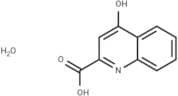
CAS 345909-35-5
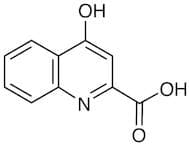
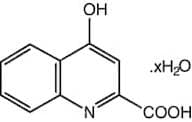
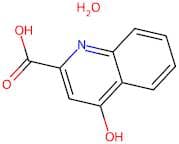
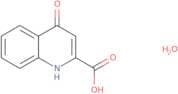
:4-Hydroxyquinoline-2-carboxylic acid hydrate
Description:
4-Hydroxyquinoline-2-carboxylic acid hydrate is an organic compound characterized by its quinoline structure, which features a hydroxyl group and a carboxylic acid functional group. This compound typically appears as a crystalline solid and is known for its potential applications in pharmaceuticals and biochemistry, particularly as a building block in the synthesis of various bioactive molecules. The presence of the hydroxyl group contributes to its solubility in polar solvents, while the carboxylic acid group can participate in hydrogen bonding and other interactions, enhancing its reactivity. The hydrate form indicates that it contains water molecules in its crystal structure, which can influence its physical properties, such as melting point and solubility. Additionally, 4-Hydroxyquinoline-2-carboxylic acid hydrate may exhibit biological activity, making it of interest in medicinal chemistry and research related to antimicrobial or anti-inflammatory properties. As with many organic compounds, proper handling and storage are essential to maintain its stability and efficacy.
Formula:C10H6NO3
InChI:InChI=1/C10H7NO3/c12-9-5-8(10(13)14)11-7-4-2-1-3-6(7)9/h1-5H,(H,11,12)(H,13,14)/p-1
SMILES:c1ccc2c(c1)c(=O)cc(C(=O)[O-])[nH]2
Synonyms:- 4-hydroxy-Quinaldate
- 4-Hydroxyquinaldate
- 4-Hydroxyquinaldinate
- 4-Hydroxyquinoline-2-carboxylate
- Kynurenate
- 4-Oxo-1,4-Dihydroquinoline-2-Carboxylate
Sort by
Purity (%)
0
100
|
0
|
50
|
90
|
95
|
100
Found 6 products.
Kynurenic Acid
CAS:Formula:C10H7NO3Purity:>98.0%(T)(HPLC)Color and Shape:White to Gray to Brown powder to crystalMolecular weight:189.174-Hydroxyquinoline-2-carboxylic acid hydrate, 98%
CAS:Broad spectrum excitatory amino acid antagonist4-Hydroxyquinoline-2-carboxylic acid hydrate is used as an intermediate in synthetic chemistry. It acts as an antiexcitotoxic and anticonvulsant. It finds application in certain neurobiological disorders therapy. This Thermo Scientific Chemicals brandFormula:C10H7NO3Purity:98%Color and Shape:Dark cream to cream to yellow to green to pale brown to pale gray to gray, PowderMolecular weight:189.174-HYDROXYQUINOLINE-2-CARBOXYLIC ACID, HYDRATE, 98
CAS:Formula:C10H9NO4Purity:95%Color and Shape:SolidMolecular weight:207.18284-Hydroxyquinoline-2-carboxylic acid hydrate
CAS:4-Hydroxyquinoline-2-carboxylic acid hydrateFormula:C10H7NO3·H2OPurity:≥95%Color and Shape: faint yellow/ green solidMolecular weight:207.18g/mol4-Hydroxyquinoline-2-carboxylic acid hydrate
CAS:4-Hydroxyquinoline-2-carboxylic acid hydrate is a neuroprotective agent that has been shown to be effective in the treatment of neurodegenerative diseases. It is a solvate, which means that it can form crystals with water molecules and is capable of hydrogen bonding. The quinolinecarboxylic acid moiety of 4-hydroxyquinoline-2-carboxylic acid hydrate has been shown to have neuroprotective effects against neurotoxicity induced by kynurenic acid, an endogenous compound. 4-Hydroxyquinoline-2-carboxylic acid hydrate has broad spectrum activity and can be used as a broad spectrum neuroprotective agent. The molecule also displays polymorphism with tautomeric behaviour and diffraction properties.Formula:C10H7NO3·H2OPurity:Min. 95%Molecular weight:189.17 g/molKynurenic Acid hydrate
CAS:Kynurenic acid, an active metabolite of tryptophan, is synthesized through a kynurenine intermediate by kynurenine aminotransferases (KATs). It acts as an antagonist of both NMDA and AMPA receptors, as well as α7 nicotinic acetylcholine receptors (nAChRs; EC50s = 235, 101, and 7 µM, respectively), and functions as an agonist for the aryl hydrocarbon receptor (AhR) and G protein-coupled receptor 35 (GPR35; EC50s = 1.4 and 39 µM, respectively). In a neonatal rat model of cerebral hypoxic-ischemia, induced by carotid artery ligation, administration of kynurenic acid at 300 mg/kg prevents weight loss in the lesioned hemisphere. Additionally, at concentrations of 1 and 5 mg/ml, it protects against neurodegeneration in the rhabdomere of the eye in an Htt93QtransgenicDrosophila model of Huntington's disease. Elevated levels of kynurenic acid in the cerebrospinal fluid have been observed in patients with schizophrenia.Formula:C10H9NO4Color and Shape:SolidMolecular weight:207.185