CAS 3464-18-4
:2,5-Pyrrolidinedione, 3-phenyl-
Description:
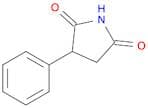
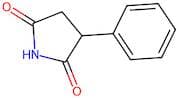
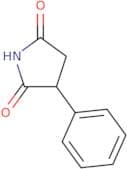
2,5-Pyrrolidinedione, 3-phenyl-, also known as N-phenyl-2,5-pyrrolidinedione, is an organic compound characterized by its cyclic structure featuring a pyrrolidine ring with two carbonyl groups (ketones) at the 2 and 5 positions and a phenyl group at the 3 position. This compound typically appears as a solid at room temperature and is soluble in organic solvents. It exhibits properties such as being a potential intermediate in organic synthesis and may participate in various chemical reactions, including nucleophilic additions and cycloadditions. The presence of the phenyl group can influence its reactivity and stability, making it of interest in medicinal chemistry and materials science. Additionally, its structure suggests potential applications in the development of dyes, pharmaceuticals, or agrochemicals. As with many organic compounds, safety precautions should be taken when handling it, as it may pose health risks or environmental hazards.
Formula:C10H9NO2
Sort by
Purity (%)
0
100
|
0
|
50
|
90
|
95
|
100
Found 4 products.
3-Phenylpyrrolidine-2,5-dione
CAS:Formula:C10H9NO2Purity:98%Color and Shape:SolidMolecular weight:175.18403-Phenylpyrrolidine-2,5-dione
CAS:3-Phenylpyrrolidine-2,5-dionePurity:98%Molecular weight:175.19g/mol3-Phenylpyrrolidine-2,5-dione
CAS:3-Phenylpyrrolidine-2,5-dione is an organic compound with a polymer film. It has been shown to have antireflection properties and can be used for optical applications. 3-Phenylpyrrolidine-2,5-dione can be made by the reaction of hydrochloric acid and an organic solvent. It is soluble in methyl ethyl ketone and hydroxyl group. The colorless compound has a melting point of 104 degrees Celsius and decomposes at around 250 degrees Celsius. 3-Phenylpyrrolidine-2,5-dione is soluble in aromatic hydrocarbons such as naphthalene and structural formula consists of a benzene ring fused to a pyrrole ring with a carbonyl group on each side. 3-Phenylpyrrolidine-2,5-dione has been shown to have good thermal expansion properties which are useful for patterning or moldFormula:C10H9NO2Purity:Min. 95%Molecular weight:175.18 g/mol