CAS 34662-28-7
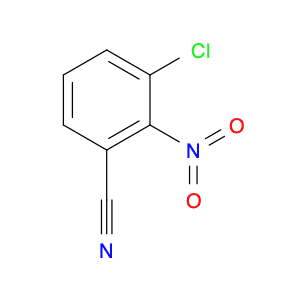
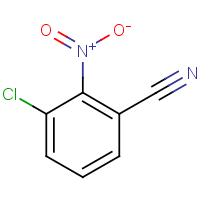
:3-Chloro-2-nitrobenzonitrile
Description:
3-Chloro-2-nitrobenzonitrile is an organic compound characterized by its aromatic structure, which includes a benzene ring substituted with both a chloro group and a nitro group, as well as a cyano group. The presence of these functional groups contributes to its chemical reactivity and properties. The chloro group typically enhances the compound's electrophilicity, while the nitro group is a strong electron-withdrawing group, influencing the compound's reactivity in electrophilic aromatic substitution reactions. The cyano group, being a strong electron-withdrawing group as well, can also affect the compound's solubility and polarity. This compound is generally used in organic synthesis and may serve as an intermediate in the production of pharmaceuticals or agrochemicals. It is important to handle 3-Chloro-2-nitrobenzonitrile with care, as it may pose health risks, including toxicity and environmental hazards. Proper safety measures should be observed when working with this compound in a laboratory setting.
Formula:C7H3ClN2O2
InChI:InChI=1S/C7H3ClN2O2/c8-6-3-1-2-5(4-9)7(6)10(11)12/h1-3H
InChI key:InChIKey=HXBSPURMEQYSSS-UHFFFAOYSA-N
SMILES:N(=O)(=O)C1=C(C#N)C=CC=C1Cl
Synonyms:- 3-Chlor-2-nitrobenzonitril
- Benzonitrile, 3-chloro-2-nitro-
- Nitrochlorobenzonitrile
- 3-Chloro-2-nitrobenzonitrile
Sort by
Purity (%)
0
100
|
0
|
50
|
90
|
95
|
100
Found 4 products.
3-Chloro-2-nitrobenzonitrile
CAS:Formula:C7H3ClN2O2Purity:96%Color and Shape:SolidMolecular weight:182.56393-Chloro-2-nitrobenzonitrile
CAS:3-Chloro-2-nitrobenzonitrileFormula:C7H3ClN2O2Purity:98%Color and Shape: pale yellow solidMolecular weight:182.56g/mol3-Chloro-2-nitrobenzonitrile
CAS:3-Chloro-2-nitrobenzonitrile is a postulated intermediate in the synthesis of benzoic acid and isomers. It can be obtained by reacting phosphorus pentachloride with an aromatic compound containing a benzene ring with substituents that contain nitrile groups. The reaction of 3-chloro-2-nitrobenzonitrile with water produces benzoic acid. This transformation is attributed to the formation of an unstable intermediate, which then decomposes to form a more stable product.
Formula:C7H3ClN2O2Purity:Min. 95%Molecular weight:182.56 g/molRef: 3D-JBA66228
Discontinued product