CAS 34900-01-1
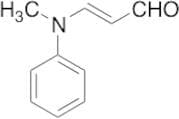
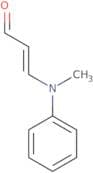
:(2E)-3-(Methylphenylamino)-2-propenal
Description:
(2E)-3-(Methylphenylamino)-2-propenal, with the CAS number 34900-01-1, is an organic compound characterized by its structure, which features a propenal backbone with a methylphenylamino group. This compound typically exhibits properties associated with both aldehydes and amines, including reactivity due to the presence of the aldehyde functional group, which can participate in various chemical reactions such as nucleophilic addition and condensation. The methylphenylamino substituent contributes to its potential biological activity and may influence its solubility and polarity. In terms of physical properties, compounds of this nature often have moderate boiling points and can be sensitive to light and air, necessitating careful handling and storage. The presence of the double bond in the propenal structure also suggests potential for isomerization and other reactions under certain conditions. Overall, (2E)-3-(Methylphenylamino)-2-propenal is of interest in organic synthesis and may have applications in pharmaceuticals or agrochemicals, depending on its specific reactivity and biological properties.
Formula:C10H11NO
InChI:InChI=1S/C10H11NO/c1-11(8-5-9-12)10-6-3-2-4-7-10/h2-9H,1H3/b8-5+
InChI key:InChIKey=YLMOTKLYENPQLK-VMPITWQZSA-N
SMILES:N(/C=C/C=O)(C)C1=CC=CC=C1
Synonyms:- (2E)-3-(Methylphenylamino)-2-propenal
- (2E)-3-[Methyl(phenyl)amino]acrylaldehyde
- 2-Propenal, 3-(methylphenylamino)-, (E)-
- 2-propenal, 3-(methylphenylamino)-, (2E)-
- 3-N-Methyl-N-Phenylaminoacroleini
- trans-3-(N-Methylanilino)acrolein
Sort by
Purity (%)
0
100
|
0
|
50
|
90
|
95
|
100
Found 2 products.
trans 3-(N-Methylanilino)acrolein
CAS:Controlled ProductApplications trans 3-(N-Methylanilino)acrolein (cas# 34900-01-1) is a compound useful in organic synthesis.
Formula:C10H11NOColor and Shape:NeatMolecular weight:161.2trans 3-(N-Methylanilino)acrolein
CAS:Trans 3-(N-Methylanilino)acrolein is a catalyst that can be used in the synthesis of benzimidazoles. It reacts with dichloride and irradiation to produce benzimidazoles. The yields are dependent on the amount of microwave irradiation used and can be increased by using microwave irradiation. This catalyst is prepared by reacting 3-(N-methylanilino)acrolein with dichloride in a solvent such as tetrahydrofuran (THF). Trans 3-(N-Methylanilino)acrolein has been shown to have high reactivity and reactivity rates, which make it an effective catalyst for this reaction.
Formula:C10H11NOPurity:Min. 95%Color and Shape:Yellow To Dark Brown SolidMolecular weight:161.2 g/molRef: 3D-FM25783
Discontinued product