CAS 35109-88-7
:2-Iodoadenosine
Description:
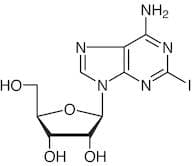
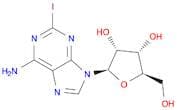
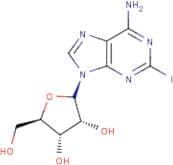
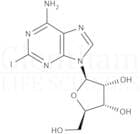
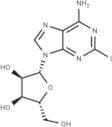
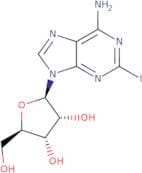
2-Iodoadenosine is a modified nucleoside that features an iodine atom substituted at the 2-position of the adenine base. This compound is characterized by its structural similarity to adenosine, which consists of a ribose sugar linked to an adenine base. The introduction of the iodine atom can influence the compound's biological activity, stability, and interaction with various enzymes and receptors. 2-Iodoadenosine is often studied for its potential roles in cellular signaling and as a tool in biochemical research, particularly in the context of purinergic signaling pathways. It may exhibit unique pharmacological properties compared to its unmodified counterpart, adenosine, and can be utilized in various experimental applications, including studies on receptor binding and cellular uptake. Additionally, the presence of the iodine atom can enhance the compound's visibility in imaging studies. Overall, 2-Iodoadenosine serves as an important compound in the field of medicinal chemistry and biochemistry, contributing to our understanding of nucleoside function and signaling mechanisms.
Formula:C10H12IN5O4
InChI:InChI=1/C10H12IN5O4/c11-10-14-7(12)4-8(15-10)16(2-13-4)9-6(19)5(18)3(1-17)20-9/h2-3,5-6,9,17-19H,1H2,(H2,12,14,15)/t3-,5-,6-,9-/m1/s1
SMILES:C([C@@H]1[C@H]([C@H]([C@H](n2cnc3c(N)nc(I)nc23)O1)O)O)O
Synonyms:- Adenosine, 2-iodo-
Sort by
Purity (%)
0
100
|
0
|
50
|
90
|
95
|
100
Found 8 products.
2-Iodoadenosine
CAS:Formula:C10H12IN5O4Purity:>98.0%(HPLC)(N)Color and Shape:White to Orange to Green powder to crystalMolecular weight:393.142-Iodoadenosine
CAS:Nucleosides Derivatives –Halo-nucleosides; Scaffolds and TemplatesFormula:C10H12IN5O4Color and Shape:SolidMolecular weight:393.14Ref: TM-TNU0156
5mgTo inquire10mgTo inquire25mgTo inquire50mgTo inquire100mgTo inquire500mgTo inquire2-Iodoadenosine
CAS:2-Iodoadenosine is a chemical compound that is produced from the oxidation of uridine. It is used in the synthesis of peptides, which are important for biological processes like signal transduction and cell growth. 2-Iodoadenosine can be made by coupling other molecules to an adenosine molecule. This process involves a cross-coupling reaction with palladium catalysts or hydroxylation reactions with sodium borohydride. The resulting product has been shown to have anticancer and anti-microbial activities against protozoan parasites and cyclic peptide structures.Formula:C10H12IN5O4Purity:Min. 97 Area-%Color and Shape:PowderMolecular weight:393.14 g/mol2-Iodo Adenosine
CAS:Controlled ProductApplications An intermediate in the synthesis of isoguanosine (crotonoside or 2-hydroxyadenosine), a naturally occuring nucleoside analogue of guanosine. Isoguanosine is incorporated into mammalian but not bacterial nucleic acids, stimulates the accumulation of cyclic AMP in the brain, and is an inhibitor of IMP:pyrophosphorylase.
References Lowry, B.A., et al.: J. Biol. Chem., 197, 591 (1952), Huang, M., et al.: J. Med. Chem., 15, 462 (1972), Hagen, C., et al.: Biochem. Biophys. Acta, 293, 105 (1973),Formula:C10H12IN5O4Color and Shape:NeatMolecular weight:393.14