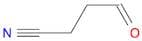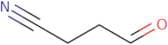
CAS 3515-93-3
:4-Oxobutanenitrile
Description:
4-Oxobutanenitrile, also known by its IUPAC name 4-cyanobutan-2-one, is an organic compound characterized by the presence of both a nitrile group (-C≡N) and a ketone group (C=O) within a four-carbon chain. Its molecular formula is C4H5NO, indicating it contains four carbon atoms, five hydrogen atoms, one nitrogen atom, and one oxygen atom. This compound typically appears as a colorless to pale yellow liquid with a distinctive odor. It is soluble in polar solvents such as water and alcohols, which is attributed to the presence of the polar nitrile and carbonyl functional groups. 4-Oxobutanenitrile is used in organic synthesis, particularly in the production of various pharmaceuticals and agrochemicals, due to its reactivity and ability to participate in nucleophilic addition reactions. Additionally, it may exhibit moderate toxicity, necessitating appropriate safety precautions during handling and use. As with many organic compounds, its stability and reactivity can be influenced by environmental conditions such as temperature and pH.
Formula:C4H5NO
InChI:InChI=1S/C4H5NO/c5-3-1-2-4-6/h4H,1-2H2
InChI key:InChIKey=CGFGIKNLZTZJDE-UHFFFAOYSA-N
SMILES:C(CC=O)C#N
Synonyms:- 3-Cyanopropanal
- 3-Cyanopropionaldehyde
- 3-Formylpropionitrile
- 4-Oxobutanenitrile
- 4-Oxobutyronitrile
- Butanenitrile, 4-oxo-
- Propionaldehyde, 3-cyano-
- Succinaldehydonitrile
- β-Cyanopropionaldehyde
- β-Cyanopropionic aldehyde
Sort by
Purity (%)
0
100
|
0
|
50
|
90
|
95
|
100
Found 3 products.
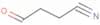
3-Cyanopropanal
CAS:3-Cyanopropanal is a copolymerization agent that is used in the production of polyacrylonitrile. It can be synthesized by reduction of acrylic acid with sodium borohydride and hydrogen cyanide, or by alkylation of propanol with acrylonitrile in the presence of an acidic catalyst. 3-Cyanopropanal has been shown to adsorb onto organic molecules such as chalcones, alkyl halides, and amino acids. This reaction mechanism is due to its weakly acidic character and high affinity for these compounds. 3-Cyanopropanal also has a low bioavailability because it is metabolized into vinyl alcohol and ester hydrochloride, which are not readily absorbed by the body.Formula:C4H5NOPurity:Min. 95%Color and Shape:Clear LiquidMolecular weight:83.09 g/mol