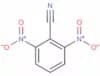
CAS 35213-00-4
:2,6-Dinitrobenzonitrile
Description:
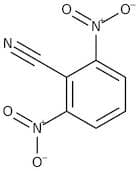
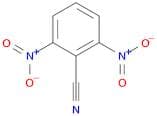
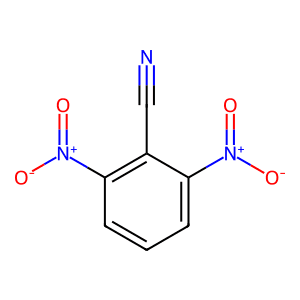
2,6-Dinitrobenzonitrile is an organic compound characterized by the presence of two nitro groups (-NO2) and a cyano group (-CN) attached to a benzene ring. Its molecular structure features a benzene ring substituted at the 2 and 6 positions with nitro groups, while the cyano group is located at the 1 position. This compound is typically a yellow crystalline solid and is known for its relatively high stability under standard conditions. It is sparingly soluble in water but more soluble in organic solvents such as acetone and ethanol. 2,6-Dinitrobenzonitrile is primarily used in organic synthesis and as an intermediate in the production of various chemical compounds, including pharmaceuticals and agrochemicals. Due to the presence of nitro groups, it exhibits significant reactivity, particularly in electrophilic substitution reactions. Additionally, it may pose environmental and health risks, necessitating careful handling and disposal in accordance with safety regulations.
Formula:C7H3N3O4
InChI:InChI=1/C7H3N3O4/c8-4-5-2-1-3-6(9(11)12)7(5)10(13)14/h1-3H
SMILES:c1cc(C#N)c(c(c1)N(=O)=O)N(=O)=O
Synonyms:- Dinitrobenzonitrile
- Benzonitrile, 2,6-dinitro-
- 2,3-Dinitrobenzonitrile
Sort by
Purity (%)
0
100
|
0
|
50
|
90
|
95
|
100
Found 5 products.
2,6-Dinitrobenzonitrile, 98+%
CAS:This Thermo Scientific Chemicals brand product was originally part of the Alfa Aesar product portfolio. Some documentation and label information may refer to the legacy brand. The original Alfa Aesar product / item code or SKU reference has not changed as a part of the brand transition to Thermo SciFormula:C7H3N3O4Purity:98+%Color and Shape:Crystals or powder or crystalline powder, Cream to yellow to brownMolecular weight:193.122,6-Dinitrobenzonitrile
CAS:2,6-Dinitrobenzonitrile inhibits nitrobenzene by reacting with the electron-rich nitro group to form a stable radical. This reaction is a nucleophilic attack that results in the formation of an electron-deficient intermediate. The intermediate can react with other molecules to form isomeric products. Nitrosamines are formed when 2,6-dinitrobenzonitrile reacts with nitrosamines and amines. These compounds have been shown to cause cancer in laboratory animals. 2,6-Dinitrobenzonitrile has been used as a radiosensitizer for cancer therapy and as an analytical reagent for detection of nitrates in water. It has also been used for staining proteins and DNA samples on microscope slides and as a photographic developer for silver halide films.Formula:C7H3N3O4Purity:Min. 95%Molecular weight:193.12 g/mol