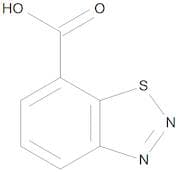
CAS 35272-27-6
:1,2,3-Benzothiadiazole-7-carboxylic acid
Description:
1,2,3-Benzothiadiazole-7-carboxylic acid is a heterocyclic compound characterized by a benzothiadiazole core, which consists of a benzene ring fused to a thiadiazole ring. This compound features a carboxylic acid functional group at the 7-position of the benzothiadiazole structure, contributing to its acidic properties. It is typically a crystalline solid and is soluble in polar solvents, which enhances its utility in various chemical applications. The presence of both the thiadiazole and carboxylic acid groups allows for potential interactions in biological systems, making it of interest in medicinal chemistry and materials science. Additionally, this compound may exhibit fluorescence properties, which can be advantageous in applications such as sensors or dyes. Its unique structure and functional groups enable it to participate in various chemical reactions, including coupling reactions and derivatization, further expanding its applicability in organic synthesis and research. Overall, 1,2,3-Benzothiadiazole-7-carboxylic acid is a versatile compound with significant potential in both academic and industrial settings.
Formula:C7H4N2O2S
InChI:InChI=1S/C7H4N2O2S/c10-7(11)4-2-1-3-5-6(4)12-9-8-5/h1-3H,(H,10,11)
InChI key:InChIKey=COAIOOWBEPAOFY-UHFFFAOYSA-N
SMILES:C(O)(=O)C1=C2C(N=NS2)=CC=C1
Synonyms:- 1,2,3-Benzothiadiazole-7-carboxylic acid
- Cga 210007
Sort by
Purity (%)
0
100
|
0
|
50
|
90
|
95
|
100
Found 8 products.
Benzo[d][1,2,3]thiadiazole-7-carboxylic acid
CAS:Formula:C7H4N2O2SPurity:97%Color and Shape:SolidMolecular weight:180.1839Benzo[d][1,2,3]thiadiazole-7-carboxylic acid
CAS:Benzo[d][1,2,3]thiadiazole-7-carboxylic acidPurity:97%Molecular weight:180.19g/molAcibenzolar acid 100 µg/mL in Acetonitrile
CAS:Formula:C7H4N2O2SColor and Shape:Single SolutionMolecular weight:180.181,2,3-Benzothiadiazole-7-carboxylic acid
CAS:Benzothiadiazole-7-carboxylic acid (BTHCA) is an activated compound that has been shown to have potent bactericidal activity. It is a member of the benzothiadiazole family of compounds, which are found in the environment and have been detected in human blood. BTHCA inhibits the enzyme hydroxycinnamoyltransferase, which leads to a decrease in shikimate production and folate levels. BTHCA also reversibly inhibits methionine synthase, leading to an accumulation of homocysteine and methionine, which are toxic substances that lead to DNA damage and cell death. This compound has been used as a pesticide for plants by blocking plant protein synthesis. Analysis of BTHCA has shown it is metabolized into p-coumaric acid, which may be responsible for its observed anti-inflammatory effects.Formula:C7H4N2O2SPurity:Min. 95%Molecular weight:180.19 g/mol
![Benzo[d][1,2,3]thiadiazole-7-carboxylic acid](/_next/image/?url=https%3A%2Fstatic.cymitquimica.com%2Fproducts%2FIN%2Fthumb%2FDA00CHPR.jpg&w=3840&q=75)

![Benzo[d][1,2,3]thiadiazole-7-carboxylic acid](/_next/image/?url=https%3A%2Fstatic.cymitquimica.com%2Fproducts%2F54%2Fthumb%2FOR1035187.jpg&w=3840&q=75)