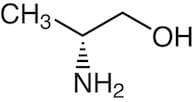
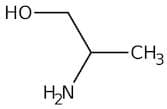
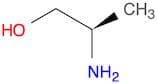
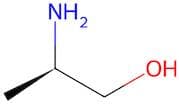
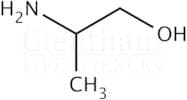
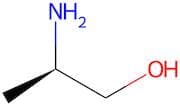
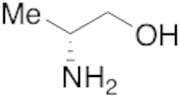
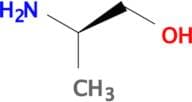
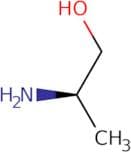
CAS 35320-23-1
:D-Alaninol
- (R)-1-Amino-2-propanol
- (R)-1-Aminopropan-2-ol
- (R)-(-)-2-Amino-1-propanol
- D-amine propionic acid
- DL-ALANINOL
- DL-ALANILOL
- H-D-ALA-OL
- (R)-(-)-2-AMINOPROPANOL
- D-2-AMINO-PROPANOL
- DL-2-AMINOPROPYL-ALCOHOL
- H-DL-ALA-OL
- 2-AMINO PROPANOL
- DL-2-AMINO PROPANOL
- D-(-)-ALANINOL
- D-ALANINOL
- DL-2-AMINO-1-PROPANOL
- H-D-ALANINOL
- D-ALAOH
- (+/-)-2-AMINO-1-PROPANOL
- See more synonyms
(R)-(-)-2-Amino-1-propanol
CAS:Formula:C3H9NOPurity:>98.0%(GC)(T)Color and Shape:Colorless to Light yellow to Light orange clear liquidMolecular weight:75.11(R)-(-)-2-Amino-1-propanol, 98%
CAS:(R)-(-)-2-Amino-1-propanol is used as a chiral intermediate for the synthesis of pharmaceutical products and agrochemicals. It acts as additives in health care products and animal feed. This Thermo Scientific Chemicals brand product was originally part of the Alfa Aesar product portfolio. Some docFormula:C3H9NOPurity:98%Color and Shape:Liquid or viscous liquid, Clear colorless to yellow to greenMolecular weight:75.11D-Alaninol
CAS:D-AlaninolFormula:C3H9NOPurity:By gc: 99.9% by area (Typical Value in Batch COA)Color and Shape: clear. colourless liquidMolecular weight:75.11g/mol(R)-(-)-2-Amino-1-propanol
CAS:Formula:C3H9NOPurity:≥ 98.0%Color and Shape:Clear, colourless to light yellow liquidMolecular weight:75.11(2R)-2-Aminopropan-1-ol
CAS:(2R)-2-Aminopropan-1-olFormula:C3H9NOPurity:≥95%Color and Shape: clear. colourless liquidMolecular weight:75.11g/mol(R)-(-)-2-Amino-1-propanol
CAS:Controlled ProductApplications (R)-(-)-2-Amino-1-propanol is used as a reagent in the synthesis of naphthyridinone integrase inhibitors.
Not a dangerous good if item is equal to or less than 1g/ml and there is less than 100g/ml in the package
References Johns, B.A., et al.: Bioorg. Med. Chem. Lett., 24, 3104 (2014)Formula:C3H9NOColor and Shape:NeatMolecular weight:75.1097D-Alaninol
CAS:D-Alaninol is a group p2 molecule that contains a methyl ethyl, hydroxyl group, and a hydroxy group. It has been shown to have antimicrobial activity against human pathogens such as Micrococcin P1, which is found in the environment and on skin. D-Alaninol has been shown to be effective at low concentrations with no adverse effects on mammalian cells. The antimicrobial effect of D-alaninol may be due to its ability to form an amide bond with the peptidoglycan cell wall of bacteria. This leads to disruption of the bacterial cell membrane and death. The binding affinity of D-alaninol for α1-acid glycoprotein leads to adsorption onto this protein following oral administration, which may affect its pharmacokinetic properties.
Formula:C3H9NOPurity:Min. 98 Area-%Molecular weight:75.11 g/mol