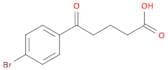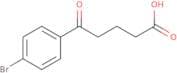
CAS 35333-26-7
:5-(4-bromophenyl)-5-oxopentanoic acid
Description:
5-(4-Bromophenyl)-5-oxopentanoic acid, with the CAS number 35333-26-7, is an organic compound characterized by its unique structure, which includes a pentanoic acid backbone substituted with a 4-bromophenyl group and a ketone functional group. This compound typically appears as a solid at room temperature and is soluble in organic solvents, reflecting its hydrophobic characteristics due to the aromatic bromophenyl moiety. The presence of both the carboxylic acid and ketone functional groups suggests that it may exhibit acidic properties and participate in various chemical reactions, such as esterification or condensation. Additionally, the bromine atom introduces notable electronegativity, potentially influencing the compound's reactivity and interactions with other molecules. This compound may be of interest in pharmaceutical research or organic synthesis due to its potential biological activity and utility in the development of new chemical entities. Safety data should be consulted for handling and storage, as with all chemical substances.
Formula:C11H11BrO3
InChI:InChI=1/C11H11BrO3/c12-9-6-4-8(5-7-9)10(13)2-1-3-11(14)15/h4-7H,1-3H2,(H,14,15)
SMILES:C(CC(=O)c1ccc(cc1)Br)CC(=O)O
Sort by
Purity (%)
0
100
|
0
|
50
|
90
|
95
|
100
Found 3 products.
5-(4-Bromophenyl)-5-oxovaleric acid
CAS:Formula:C11H11BrO3Purity:97%Color and Shape:SolidMolecular weight:271.10725-(4-Bromophenyl)-5-oxovaleric acid
CAS:<p>5-(4-Bromophenyl)-5-oxovaleric acid is a molecule that has been synthesized to be used as a cancer drug. It is an amide derivative of the natural compound valproic acid and is being developed for the treatment of cancers, such as leukemia and melanoma. 5-(4-Bromophenyl)-5-oxovaleric acid has been shown to inhibit the function of integrin, which plays a role in cell adhesion and migration, with potential applications in wound healing. <br>The molecule has also been shown to have chemokine binding properties and may be useful in the treatment of diseases where chemokines are involved, such as HIV or AIDS. This compound also binds to CCR5 receptor and inhibits HIV entry into cells. The molecule has also been shown to antagonize survivin, an antiapoptotic protein that protects cells from undergoing apoptosis and prevents tumor suppression. The affinity of 5-(4-bromophenyl</p>Formula:C11H11BrO3Purity:Min. 95%Molecular weight:271.12 g/mol