CAS 35458-39-0
:4-bromo-2,5-dimethoxybenzoic acid
Description:
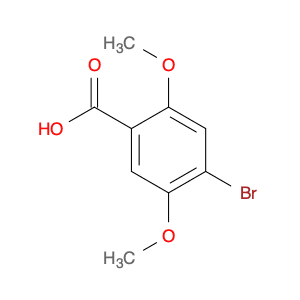
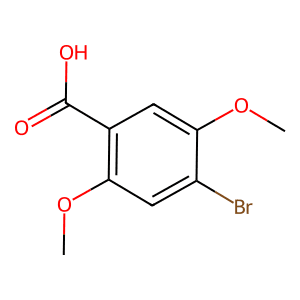
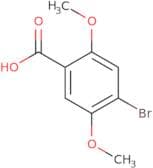
4-Bromo-2,5-dimethoxybenzoic acid is an aromatic carboxylic acid characterized by the presence of a bromine atom and two methoxy groups on a benzene ring. The compound features a carboxylic acid functional group (-COOH) that contributes to its acidic properties. The bromine substituent, located at the para position relative to the carboxylic acid, influences the compound's reactivity and polarity. The methoxy groups, located at the 2 and 5 positions, enhance the compound's solubility in organic solvents and can also affect its electronic properties, making it a potential candidate for various chemical reactions, including electrophilic substitutions. This compound is typically used in organic synthesis and may serve as an intermediate in the production of pharmaceuticals or agrochemicals. Its molecular structure allows for potential applications in materials science and medicinal chemistry, where modifications can lead to derivatives with specific biological activities. As with many organic compounds, proper handling and safety precautions are essential due to its chemical nature.
Formula:C9H9BrO4
InChI:InChI=1/C9H9BrO4/c1-13-7-4-6(10)8(14-2)3-5(7)9(11)12/h3-4H,1-2H3,(H,11,12)
SMILES:COc1cc(c(cc1C(=O)O)OC)Br
Sort by
Purity (%)
0
100
|
0
|
50
|
90
|
95
|
100
Found 4 products.
4-Bromo-2,5-dimethoxybenzoic acid
CAS:Formula:C9H9BrO4Purity:97%Color and Shape:SolidMolecular weight:261.06944-Bromo-2,5-dimethoxybenzoic acid
CAS:4-Bromo-2,5-dimethoxybenzoic acidPurity:98%Molecular weight:261.07g/mol4-Bromo-2,5-dimethoxybenzoic acid
CAS:4-Bromo-2,5-dimethoxybenzoic acid (BDMA) is a chemical compound that has been used as an intermediate in the synthesis of pharmaceuticals. It is also used as a precursor for the synthesis of other compounds. BDMA has been shown to be toxic to both humans and monkeys, with toxic effects including convulsions, dyspnea, mydriasis, vomiting, and coma. The toxicological profile is not well understood because it has not been extensively studied. Studies have shown that BDMA undergoes oxidative deamination to form 4-bromo-2,5-dimethoxyamphetamine (DOB), which can cause hallucinations and nausea when ingested.
Formula:C9H9BrO4Purity:Min. 95%Molecular weight:261.07 g/mol