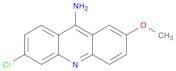
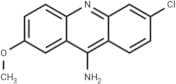
CAS 3548-09-2
:6-Chloro-2-methoxy-9-acridinamine
Description:
6-Chloro-2-methoxy-9-acridinamine, with the CAS number 3548-09-2, is a chemical compound that belongs to the acridine family, characterized by its fused ring structure which contributes to its planar geometry and potential intercalating properties with nucleic acids. This compound features a chloro substituent at the 6-position and a methoxy group at the 2-position of the acridine ring, which can influence its solubility and reactivity. The presence of the amino group at the 9-position enhances its potential as a biological agent, possibly exhibiting antimicrobial or antitumor activities. The compound's unique structure allows for various interactions with biological macromolecules, making it of interest in medicinal chemistry. Its physical properties, such as melting point, boiling point, and solubility, can vary based on the specific conditions and solvents used. As with many acridine derivatives, it may also exhibit fluorescence, which can be useful in biological imaging applications. Safety and handling precautions should be observed due to its potential biological activity and toxicity.
Formula:C14H11ClN2O
InChI:InChI=1S/C14H11ClN2O/c1-18-9-3-5-12-11(7-9)14(16)10-4-2-8(15)6-13(10)17-12/h2-7H,1H3,(H2,16,17)
InChI key:InChIKey=IHHSSHCBRVYGJX-UHFFFAOYSA-N
SMILES:NC=1C2=C(N=C3C1C=CC(Cl)=C3)C=CC(OC)=C2
Synonyms:- 2-Methoxy-6-chloro-9-aminoacridine
- 3-Chloro-7-methoxy-9-aminoacridine
- 6-Chloro-2-Methoxyacridin-9-Amine
- 6-Chloro-2-methoxy-9-acridinamine
- 6-Chloro-9-amino-2-methoxyacridine
- 9-Acridinamine, 6-chloro-2-methoxy-
- 9-Amino-3-chloro-7-methoxyacridine
- 9-Amino-6-chloro-2-methoxyacridine (ACMA)
- Acridine, 9-amino-6-chloro-2-methoxy-
- G 185
- NSC 15300
Sort by
Purity (%)
0
100
|
0
|
50
|
90
|
95
|
100
Found 3 products.
6-Chloro-2-methoxy-9-acridinamine
CAS:Formula:C14H11ClN2OPurity:95%Color and Shape:SolidMolecular weight:258.70299-Amino-6-chloro-2-methoxyacridine
CAS:9-Amino-6-chloro-2-methoxyacridine serves as a pH-sensitive fluorescent probe commonly utilized to assess vacuolar pH variations upon substrate translocationFormula:C14H11ClN2OColor and Shape:SolidMolecular weight:258.7