CAS 35578-28-0
:3-Chloropropane-1-sulfonaMide
Description:
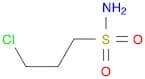
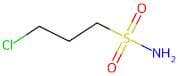
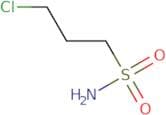
3-Chloropropane-1-sulfonamide, with the CAS number 35578-28-0, is an organic compound characterized by the presence of a sulfonamide functional group and a chlorine atom attached to a three-carbon alkyl chain. This compound typically appears as a colorless to pale yellow liquid or solid, depending on its purity and specific conditions. It is soluble in polar solvents, such as water and alcohols, due to the sulfonamide group, which can engage in hydrogen bonding. The presence of the chlorine atom introduces reactivity, making it a potential intermediate in organic synthesis and pharmaceuticals. 3-Chloropropane-1-sulfonamide may exhibit biological activity, which can be explored in medicinal chemistry. Safety data indicates that, like many sulfonamides, it may pose risks such as skin irritation or allergic reactions, necessitating proper handling and storage protocols. Overall, its unique structure and functional groups contribute to its utility in various chemical applications, particularly in the synthesis of more complex molecules.
Formula:C3H8ClNO2S
Synonyms:- 3-chloro-1-Propanesulfonamide
- 1-Propanesulfonamide, 3-chloro-
- Sulfamethoxypyridazine Impurity 1
- 3-Chloropropane-1-sulfonaMide
Sort by
Purity (%)
0
100
|
0
|
50
|
90
|
95
|
100
Found 4 products.
3-Chloropropane-1-sulfonamide
CAS:Formula:C3H8ClNO2SPurity:97%Color and Shape:SolidMolecular weight:157.61913-Chloropropane-1-sulfonamide
CAS:3-Chloropropane-1-sulfonamideFormula:C3H8ClNO2SPurity:97%Color and Shape: brown solidMolecular weight:157.62g/mol3-CHLOROPROPANE-1-SULFONAMIDE
CAS:Formula:C3H8ClNO2SPurity:97%Color and Shape:SolidMolecular weight:157.613-Chloropropane-1-sulfonamide
CAS:3-Chloropropane-1-sulfonamide is a nonabsorbable heterocyclic sulfonamide that inhibits the permeability of pyrimidines and alkenes. It is synthesized by reacting an isocyanate with a template molecule. The synthesis of 3-chloropropane-1-sulfonamide involves the reaction of an isocyanate with a pyridine or a template molecule such as 3,5-dimethoxybenzene or 2,6-diisopropylphenol. This compound can be used as an inhibitor for the synthesis of bicyclic heterocycles, such as indole and quinoline.Formula:C3H8ClNO2SPurity:Min. 95%Molecular weight:157.62 g/mol