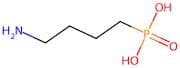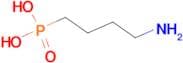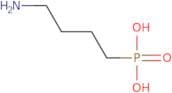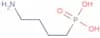
CAS 35622-27-6
:4-aminobutylphosphonic acid
Description:
4-Aminobutylphosphonic acid, with the CAS number 35622-27-6, is an organophosphorus compound characterized by its amino and phosphonic acid functional groups. It features a four-carbon chain with an amino group (-NH2) attached to the second carbon and a phosphonic acid group (-PO3H2) at the terminal position. This structure imparts both hydrophilic and hydrophobic properties, making it soluble in water and polar solvents. The compound is often studied for its potential applications in biochemistry and pharmaceuticals, particularly as a phosphonate analog of amino acids. It can act as a chelating agent and may play a role in various biological processes. Additionally, 4-aminobutylphosphonic acid can be involved in the synthesis of other chemical compounds and may exhibit biological activity, including potential neuroprotective effects. Its stability and reactivity are influenced by the presence of the phosphonic acid group, which can participate in various chemical reactions, including esterification and nucleophilic substitution.
Formula:C4H12NO3P
InChI:InChI=1/C4H12NO3P/c5-3-1-2-4-9(6,7)8/h1-5H2,(H2,6,7,8)
SMILES:C(CCP(=O)(O)O)CN
Synonyms:- 4-Abpa
- Phosphonic acid, (4-aminobutyl)-
- 4-Aminobutylphosphonic acid
Sort by
Purity (%)
0
100
|
0
|
50
|
90
|
95
|
100
Found 4 products.
4-Aminobutylphosphonic acid
CAS:Formula:C4H12NO3PPurity:97%Color and Shape:SolidMolecular weight:153.1167(4-Aminobutyl)phosphonic acid
CAS:(4-Aminobutyl)phosphonic acidPurity:98%Molecular weight:153.12g/mol4-Aminobutylphosphonic acid
CAS:4-Aminobutylphosphonic acid is a potent antagonist of the ganglion cell nicotinic acetylcholine receptors. It has been shown to produce irreversible oxidation of the ganglion cell membrane by inhibiting the enzyme catalase, which is responsible for the removal of hydrogen peroxide produced by cells. 4-Aminobutylphosphonic acid also inhibits gamma-aminobutyric acid (GABA) synthesis and increases locomotor activity in frogs. This drug also binds to functional groups on the frog’s muscle cells and stimulates a nerve impulse that causes muscle contraction. The molecule has been shown to be an effective inhibitor of x-ray diffraction data from calf thymus DNA, vinyl alcohol, and glass slides.
Formula:C4H12NO3PPurity:Min. 95%Color and Shape:PowderMolecular weight:153.12 g/mol