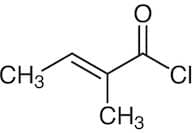
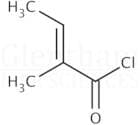
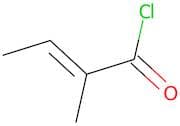
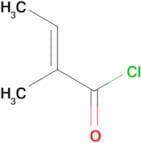
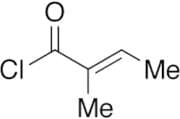
CAS 35660-94-7
:(2E)-2-Methyl-2-butenoyl chloride
Description:
(2E)-2-Methyl-2-butenoyl chloride, with the CAS number 35660-94-7, is an organic compound characterized by its structure, which features a vinyl chloride functional group attached to a butenoic acid derivative. This compound is typically a colorless to pale yellow liquid and is known for its strong, pungent odor. It is highly reactive, particularly due to the presence of the acyl chloride functional group, which makes it a potent electrophile. This reactivity allows it to participate in various chemical reactions, including acylation and nucleophilic substitution. (2E)-2-Methyl-2-butenoyl chloride is soluble in organic solvents but reacts vigorously with water, producing hydrochloric acid and corresponding carboxylic acids. As a chemical intermediate, it is often utilized in the synthesis of pharmaceuticals, agrochemicals, and other fine chemicals. Due to its reactivity and potential hazards, it should be handled with care, following appropriate safety protocols to avoid exposure and environmental contamination.
Formula:C5H7ClO
InChI:InChI=1S/C5H7ClO/c1-3-4(2)5(6)7/h3H,1-2H3/b4-3+
InChI key:InChIKey=TUNLYEHIVPWOHK-ONEGZZNKSA-N
SMILES:C(\C(Cl)=O)(=C/C)/C
Synonyms:- (2E)-2-Methyl-2-butenoyl chloride
- (2E)-2-methylbut-2-enoyl chloride
- (E)-2-Methyl-2-butenoyl chloride
- (E)-2-Methylbut-2-enoyl chloride
- 2-Butenoyl chloride, 2-methyl-, (2E)-
- 2-Butenoyl chloride, 2-methyl-, (E)-
- Tiglic acid chloride
- Tigloyl chloride
- trans-2-Methyl-2-butenoyl chloride
Sort by
Purity (%)
0
100
|
0
|
50
|
90
|
95
|
100
Found 7 products.
Tigloyl Chloride
CAS:Formula:C5H7ClOPurity:>98.0%(GC)(T)Color and Shape:Colorless to Almost colorless clear liquidMolecular weight:118.56Tigloyl Chloride
CAS:Tigloyl ChloridePurity:97%Color and Shape:Light Brown LiquidMolecular weight:118.56g/molTigloyl Chloride
CAS:Controlled ProductApplications Tigoloyl Chloride is used in the polymerization of propylene as well as through a Freidel-Crafts reaction for the preparation of permethylindenyl complexes of transition metals. As well, it is primarily used as a reagent in the enantioselective synthesis of dihydropyrans.
Not a dangerous good if item is equal to or less than 1g/ml and there is less than 100g/ml in the package
References O'Hare, D. et al.: Organometallics, 11, 48 (1992); Kaminsky, W. et al.: J. Organomet. Chem., 487, 181 (1995); Evans, D. A. et al.: J. Am. Chem. Soc., 122, 1635 (2000);Formula:C5H7ClOColor and Shape:NeatMolecular weight:118.56