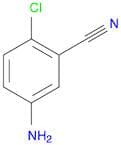
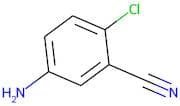
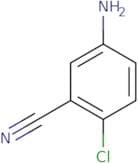
CAS 35747-58-1
:4-Chloro-3-cyanoaniline
Description:
4-Chloro-3-cyanoaniline, with the CAS number 35747-58-1, is an organic compound that features a chloro group and a cyano group attached to an aniline structure. It is characterized by its aromatic amine nature, which contributes to its chemical reactivity and potential applications in various fields. The presence of the chloro substituent enhances its electrophilic properties, making it useful in synthetic organic chemistry. The cyano group introduces a strong electron-withdrawing effect, which can influence the compound's reactivity and solubility. Typically, 4-chloro-3-cyanoaniline appears as a solid at room temperature and may exhibit moderate solubility in polar organic solvents. It is often utilized in the synthesis of dyes, pharmaceuticals, and agrochemicals due to its functional groups that allow for further chemical modifications. As with many aniline derivatives, it is important to handle this compound with care, as it may pose health risks, including potential toxicity and environmental hazards. Proper safety measures should be observed when working with this substance.
Formula:C7H5ClN2
InChI:InChI=1/C7H5ClN2/c8-7-2-1-6(10)3-5(7)4-9/h1-3H,10H2
SMILES:c1cc(c(cc1N)C#N)Cl
Synonyms:- 5-Amino-2-chlorobenzonitrile
Sort by
Purity (%)
0
100
|
0
|
50
|
90
|
95
|
100
Found 4 products.
5-Amino-2-chlorobenzonitrile
CAS:Formula:C7H5ClN2Purity:96%Color and Shape:SolidMolecular weight:152.58105-Amino-2-chlorobenzonitrile
CAS:5-Amino-2-chlorobenzonitrileFormula:C7H5ClN2Purity:97%Color and Shape: yellow solidMolecular weight:152.58g/mol5-Amino-2-chlorobenzonitrile
CAS:5-Amino-2-chlorobenzonitrile is a functional theory that has been optimised for the synthesis of pesticides. It has been shown to have high affinity constants and to be a good potential for monitoring. 5-Amino-2-chlorobenzonitrile is synthesized in the form of monoclonal antibodies, which are then optimised using vibrational frequencies. The parameters of these molecules are optimized by comparing the calculated frequencies with those obtained from experimental data. This theory can be used to develop new pesticides that are less harmful to humans and animals, as well as being more environmentally friendly.
Formula:C7H5ClN2Purity:Min. 95%Color and Shape:PowderMolecular weight:152.58 g/mol5-Amino-2-chlorobenzonitrile
CAS:Formula:C7H5ClN2Purity:96%Color and Shape:SolidMolecular weight:152.58