CAS 35840-91-6
:2-benzylpyrrolidine
Description:
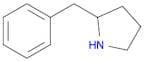
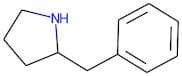
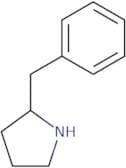
2-Benzylpyrrolidine is an organic compound characterized by its pyrrolidine ring, which is a five-membered nitrogen-containing heterocycle, substituted with a benzyl group at the second position. This structure imparts unique properties to the compound, including its potential as a chiral building block in organic synthesis and its applications in medicinal chemistry. The presence of the benzyl group enhances lipophilicity, which can influence the compound's solubility and permeability in biological systems. 2-Benzylpyrrolidine is typically a colorless to pale yellow liquid or solid, depending on its purity and specific conditions. It exhibits basic properties due to the nitrogen atom in the pyrrolidine ring, allowing it to participate in various chemical reactions, such as alkylation and acylation. Additionally, its structural features may contribute to biological activity, making it of interest in the development of pharmaceuticals. Safety data should be consulted for handling and exposure guidelines, as with any chemical substance.
Formula:C11H15N
InChI:InChI=1/C11H15N/c1-2-5-10(6-3-1)9-11-7-4-8-12-11/h1-3,5-6,11-12H,4,7-9H2
SMILES:c1ccc(cc1)CC1CCCN1
Synonyms:- Pyrrolidine, 2-(Phenylmethyl)-
Sort by
Purity (%)
0
100
|
0
|
50
|
90
|
95
|
100
Found 4 products.
2-Benzylpyrrolidine
CAS:2-BenzylpyrrolidinePurity:98%Color and Shape:LiquidMolecular weight:161.24g/mol2-Benzylpyrrolidine
CAS:Controlled Product2-Benzylpyrrolidine is a synthetic chemical that inhibits the growth of bacteria by binding to the 50S ribosomal subunit. It is active against Gram-positive and Gram-negative bacteria, including methicillin-resistant Staphylococcus aureus (MRSA). The mechanism of action for 2-benzylpyrrolidine is not fully understood, but it has been shown to inhibit protein synthesis. This effect may be due to its ability to bind to the 50S ribosomal subunit. 2-Benzylpyrrolidine also has antibacterial activity and can be used as an intermediate in the synthesis of other chemicals, including piperidine and alkene.
Formula:C11H15NPurity:Min. 95%Molecular weight:161.24 g/molRef: 3D-FB52933
Discontinued product