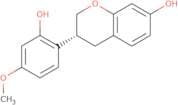
CAS 35878-41-2
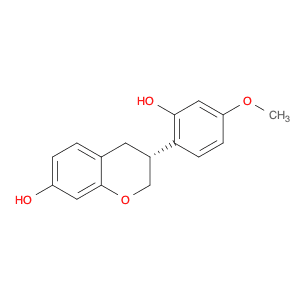
:(-)-Vestitol
Description:
(-)-Vestitol is a naturally occurring isoflavonoid, primarily found in various leguminous plants, particularly in the genus *Glycyrrhiza*. It is characterized by its chiral structure, which contributes to its biological activity. The compound exhibits antioxidant properties and has been studied for its potential health benefits, including anti-inflammatory and estrogenic effects. Its molecular formula typically includes carbon, hydrogen, and oxygen atoms, reflecting its classification as a phenolic compound. (-)-Vestitol is often investigated in the context of traditional medicine and dietary supplements, as it may play a role in modulating hormonal activity and supporting overall health. The compound's CAS number, 35878-41-2, is a unique identifier that facilitates its recognition in scientific literature and regulatory contexts. Research continues to explore its mechanisms of action and potential therapeutic applications, making it a subject of interest in both pharmacology and natural product chemistry.
Formula:C16H16O4
InChI:InChI=1S/C16H16O4/c1-19-13-4-5-14(15(18)8-13)11-6-10-2-3-12(17)7-16(10)20-9-11/h2-5,7-8,11,17-18H,6,9H2,1H3/t11-/m0/s1
InChI key:InChIKey=XRVFNNUXNVWYTI-NSHDSACASA-N
SMILES:OC1=C(C=CC(OC)=C1)[C@H]2CC=3C(OC2)=CC(O)=CC3
Synonyms:- 2H-1-Benzopyran-7-ol, 3,4-dihydro-3-(2-hydroxy-4-methoxyphenyl)-, (3R)-
- (3R)-Vestitol
- 2H-1-Benzopyran-7-ol, 3,4-dihydro-3-(2-hydroxy-4-methoxyphenyl)-, (R)-
- Vestitol, (-)-
- (3R)-3,4-Dihydro-3-(2-hydroxy-4-methoxyphenyl)-2H-1-benzopyran-7-ol
Sort by
Purity (%)
0
100
|
0
|
50
|
90
|
95
|
100
Found 5 products.
Vestitol
CAS:Vestitol is a phytoalexin with insect feeding-deterrent activity, it has antioxidant, anti-inflammatory and antimicrobial activities, it can inhibit neutrophilFormula:C16H16O4Purity:98%Color and Shape:SolidMolecular weight:272.3Vestitol
CAS:Vestitol is a naturally occurring flavonoid, which is a bioactive compound derived from various plant species. As a flavonoid, vestitol is synthesized by plants during their metabolic processes and is found predominantly in legumes such as red clover. Its biochemical mode of action includes modulation of reactive oxygen species (ROS) and interactions with cellular signaling pathways that regulate oxidative stress. By scavenging free radicals, vestitol contributes to the protection of cellular structures and biomolecules from oxidative damage.
Formula:C16H16O4Purity:Min. 95%Color and Shape:White Off-White PowderMolecular weight:272.3 g/mol