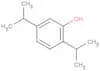
CAS 35946-91-9
:2,5-Diisopropylphenol
Description:
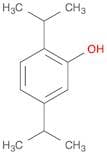
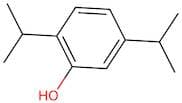
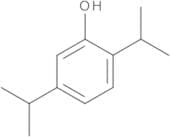
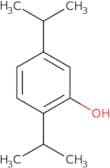
2,5-Diisopropylphenol is an organic compound characterized by its phenolic structure, featuring two isopropyl groups attached to the 2 and 5 positions of the benzene ring. This compound is typically a colorless to pale yellow liquid with a distinctive odor. It is soluble in organic solvents but has limited solubility in water due to its hydrophobic isopropyl groups. The presence of the hydroxyl (-OH) group imparts some polar characteristics, allowing for potential hydrogen bonding. 2,5-Diisopropylphenol is known for its antioxidant properties and is often utilized in various industrial applications, including as a stabilizer in plastics and as an intermediate in the synthesis of other chemical compounds. Its chemical stability and reactivity can be influenced by the steric hindrance provided by the isopropyl groups, which can affect its interactions in different chemical environments. Safety data should be consulted for handling and exposure guidelines, as with any chemical substance.
Formula:C12H18O
InChI:InChI=1/C12H18O/c1-8(2)10-5-6-11(9(3)4)12(13)7-10/h5-9,13H,1-4H3
InChI key:InChIKey=VFNUNYPYULIJSN-UHFFFAOYSA-N
SMILES:C(C)(C)C1=CC(O)=C(C(C)C)C=C1
Synonyms:- 2,5-Bis(1-methylethyl)phenol
- 2,5-Bis(propan-2-yl)phenol
- 2,5-Di(Propan-2-Yl)Phenol
- Phenol, 2,5-bis(1-methylethyl)-
- Phenol, 2,5-diisopropyl-
- 2,5-Diisopropylphenol
- Propofol Impurity 4(Propofol EP Impurity D)
- Propofol impurity D
- p-Diisopropylbenzene monoalc.
- CPD2034
- Einecs 252-807-4
- See more synonyms
Sort by
Purity (%)
0
100
|
0
|
50
|
90
|
95
|
100
Found 7 products.
2,5-bis(propan-2-yl)phenol
CAS:Formula:C12H18OPurity:95%Color and Shape:SolidMolecular weight:178.2707Propofol EP Impurity D
CAS:Formula:C12H18OColor and Shape:Off-White Semi-SolidMolecular weight:178.272,5-Diisopropylphenol
CAS:2,5-Diisopropylphenol is a phenolic compound that belongs to the group of antioxidants. It is an effective scavenger and inhibitor of lipid peroxidation. 2,5-Diisopropylphenol also inhibits nitro and hydroxy radicals, which are reactive oxygen species (ROS) that can cause membrane lipid peroxidation and other oxidative damage. This compound has been shown to have a protective effect on the liver by reducing the toxicity of some drugs. In addition, it has antibacterial activity against Gram-positive bacteria. 2,5-Diisopropylphenol's antioxidant properties are due to its ability to interact with phosphatidylcholine and prevent its oxidation by ROS. It is also glucuronidated in humans and rats.Formula:C12H18OPurity:Min. 95%Molecular weight:178.27 g/mol